

Main Findings
|
HIGHLIGHTS ■ Golden Owl identified a coordinated, foreign-operated influence network targeting Israel’s 2026 election debate. Accounts posing as Israeli citizens entered domestic political discussions and reinforced one another’s messages. The combined evidence is most consistent with an operation associated with the Islamic Republic of Iran. ■ The investigation processed 489,281 distinct data points between 22 August and 22 September 2026. The seven-platform election scan retained 21,533 relevant items; the subsequent account investigation mapped 119,717 X accounts and 294,980 relationships. These figures describe the scope of the investigation, not the size of the operation. ■ The election scan recorded 1,516 flags across ten anomaly categories, spanning misleading voting information, advance claims of fraud or postponement, impersonation and suspicious account behaviour. The categories include both content and accounts and may overlap: 1,516 counts flags, not distinct cases. The scan supplied leads for the network investigation; it does not attribute every flagged item to the identified operation. ■ Network analysis exposed a broad environment around those leads. Investigators expanded 1,170 suspicious neighbouring accounts; 1,255 accounts connected to two or more seed personas, and 2,645 carried Iran-related indicators. These populations overlap and include accounts that are not assessed as members of the operation. ■ The report documents an operational core of 35 accounts: 32 Israeli-presenting personas and three Hebrew media-style channels. Obscure sources, public-facing personas, reply accounts and amplifiers perform different roles. False identities, reused material, coordinated behaviour, account histories and platform metadata reveal the structure behind voices that appear to be independent Israeli participants. The assessment rests on this combined evidence, not on political viewpoint. ■ The manipulation targets both confidence in the vote and the interpretation of events around it. The personas carry themes of fraud, security, political responsibility and national decline into genuine Israeli debates. In the measured 30-day sample, posts by active network accounts received 947,322 impressions and 9,112 interactions. Genuine Israeli users helped circulate some of that content; they are not assessed as participants in the operation. ■ The network is assessed as linked to the Islamic Republic regime in Iran. Supporting evidence includes Iranian app data and connections to previously identified influence assets. |
The investigation's principal finding is a coordinated network of accounts that presented themselves as Israeli participants in the election debate while showing convergent evidence of foreign operation. The broad scan established that most election discussion was ordinary political activity. Account and relationship analysis then revealed a structured, coordinated layer of personas embedded within that authentic conversation.
The assessment rests on the network's combined behaviour and connections. Shared text, account histories, posting patterns, platform transparency records and the documented transfer of election messages between previously identified influence assets point to common management. The Iranian app data and connections to accounts named in the Israeli government's assessment strengthen the conclusion that the activity is associated with the Islamic Republic of Iran. Political criticism or similarity to Iranian state narratives alone would not support that conclusion.
The network's significance lies in its method of reaching domestic audiences. Its personas placed messages in Israeli political discussions, where authentic users could repeat them and extend their reach. The available evidence documents an attempt to shape voters' perceptions of political leaders, civic confidence and the electoral process. It does not establish who personally operated the accounts, which institution directed them, or whether the activity changed any voter's decision or the election outcome.
Scope and Publication Disclaimer
This report is an evidence-based open-source intelligence assessment. It is based exclusively on publicly available material and platform-published metadata observed during the stated research period. It expresses no political preference, endorsement or opposition concerning any candidate, party, government, ideology or electoral outcome.
The report does not assess the truth or merit of ordinary political opinions and does not classify criticism, accusation, protest, foreign commentary or partisan advocacy as manipulation on the basis of viewpoint. Its findings concern only conduct for which the collected data provides convergent evidence of deceptive identity presentation, coordination, foreign operation or deliberate targeting of the domestic electoral audience.
References to account names, profile names or handles identify public online accounts and do not establish the legal or civil identity of the person or persons controlling them. Inclusion in the report does not constitute an allegation that any identifiable natural person has committed a criminal, civil or regulatory offence, or knowingly acted on behalf of a foreign state.
The assessments and confidence levels in this report are analytical conclusions, not judicial findings, formal government attribution or determinations of legal liability. They reflect the information available at the time of analysis and may require revision if platforms, authorities, account operators or other sources provide reliable additional evidence.
Golden Owl has not sought to uncover private identities or obtain non-public personal data. The investigation does not have access to login records, IP addresses, device identifiers, registration information, financial records or communications that could establish the identity of operators or a formal command relationship. Accordingly, attribution is limited to the best-supported explanation of the observable data and should not be interpreted as proof of sponsorship by a specific institution or individual.
1. Introduction: an election under foreign watch
Israelis vote on 27 October 2026 in the first general election since the 7 October 2023 attack and the regional war that followed, including four rounds of direct confrontation with Iran. Polling through September showed no stable 61-seat majority for either bloc. The campaign is being fought over responsibility for 7 October, Haredi military service, the cost of living, the judiciary, and Netanyahu's political future. These are real and deeply felt Israeli debates.
They are also, for a hostile state, an opportunity. Israeli authorities have warned repeatedly that foreign actors would try to interfere. In July 2026 the head of the Shin Bet briefed a classified Knesset forum on indications of attempted foreign interference and reportedly named Iran. A joint Shin Bet and Central Elections Committee team was established. In March 2026 the Ministry for Diaspora Affairs and Combating Antisemitism described what it called Iran's active Hebrew-language influence campaign, aimed at driving fear and division among Israelis.
Iran's interest is not in who wins. Across months of Persian-language state media coverage reviewed for this report, Tehran's outlets do not endorse any Israeli candidate. What they promote is a picture of Israel as divided, betrayed by its leadership, drained by war and emigration, and heading for a crisis of legitimacy regardless of the result. An influence operation that shares that aim does not need to persuade anyone to vote for a particular party. It needs to deepen distrust, anger and despair, and to do so in a voice Israelis accept as their own.
This report documents such a voice. It follows a network of Hebrew-language accounts on X that present themselves as Israeli women, reservists, secular Tel Avivians, LGBTQ activists and religious Jerusalemites. The platform's own metadata places them in Germany, Finland, Egypt, Saudi Arabia, Yemen, Lebanon, Morocco, Bangladesh and Italy. Several connect to X through the Iranian version of its app, and they are wired, through follows, copied content and shared amplifiers, to assets Israel has attributed to Iran. The report explains how we found them, what they publish, how they reach real Israelis, and how confident we are in each conclusion.
How this report is organised
· Sections 2 to 4 describe the scale of the data, the method, and the anomalies surfaced across the election conversation.
· Sections 5 to 7 trace the network outward from the first anomalous personas Golden Owl identified, map its structure and wider footprint, and document the accounts operated through the Iranian app.
· Sections 8 to 11 set out the behavioural evidence of inauthenticity: foreign locations, fresh accounts, a shared text library, non-native language artefacts and synthetic media.
· Sections 12 and 13 analyse the content model and its alignment with Iranian state narratives.
· Sections 14 and 15 cover amplification into genuine Israeli audiences and the architecture and economy of the operation.
· Sections 16 and 17 set out attribution and confidence, and the implications for election day.
2. The scale of the investigation
This research was conducted in two phases between 22 August and 22 September 2026. Taken together, the phases processed 489,281 distinct data points: posts, account records, relationships between accounts, and platform transparency records. The figure excludes the many repeated observations of the same object that were collected along the way.
Phase 1: the open election conversation
The first phase scanned the public Israeli election conversation across seven platforms and environments over a rolling 30-day window, using multilingual keyword sets in Hebrew, Arabic, English and Russian. It collected 33,230 records. After relevance screening, 21,533 were retained as election-relevant and analysed item by item for narrative, manipulation technique, account metadata and indicators of coordination.
|
Platform |
Collected |
Retained |
Note |
|
X (Twitter) |
20,000 |
13,683 |
Full author metadata and platform location labels |
|
|
3,536 |
2,534 |
Public posts and pages |
|
|
2,707 |
1,880 |
Public posts and reels |
|
TikTok |
2,774 |
1,470 |
Public videos |
|
YouTube |
2,755 |
1,541 |
Public videos |
|
Telegram |
958 |
398 |
Public channels |
|
Dark web |
500 |
27 |
Forums and marketplaces |
|
Total |
33,230 |
21,533 |
|
By language, the retained corpus contained 11,882 Hebrew, 5,066 Arabic, 3,130 English and 1,008 Russian items.
Phase 2: the network investigation on X
The second phase moved from content to accounts. Starting from 21 seed personas, we collected each persona's profile, platform transparency panel, recent timeline including replies, the accounts that retweeted its posts, and its complete follower and following lists. We then expanded a second hop around every neighbour that looked suspicious (recently created, very few followers, or platform-located in an unexpected country). For six accounts of special interest, every single follower and followee was examined regardless of suspicion.
|
Collected object |
Volume |
|
Seed personas investigated in depth |
21 |
|
Accounts mapped (direct neighbours and second hop) |
119,717 |
|
Direct neighbours of the seeds |
6,889 |
|
Relationships between accounts (follows, retweets, quotes) |
294,980 |
|
Follow relationships |
281,858 |
|
Retweet and quote relationships |
13,122 |
|
Posts collected (seed and second-hop timelines) |
37,887 |
|
Follower and following lists retrieved in the second hop |
2,340 |
|
Platform transparency records ("About this account") |
3,467 |
|
Individual retweeter records on persona posts |
1,206 |
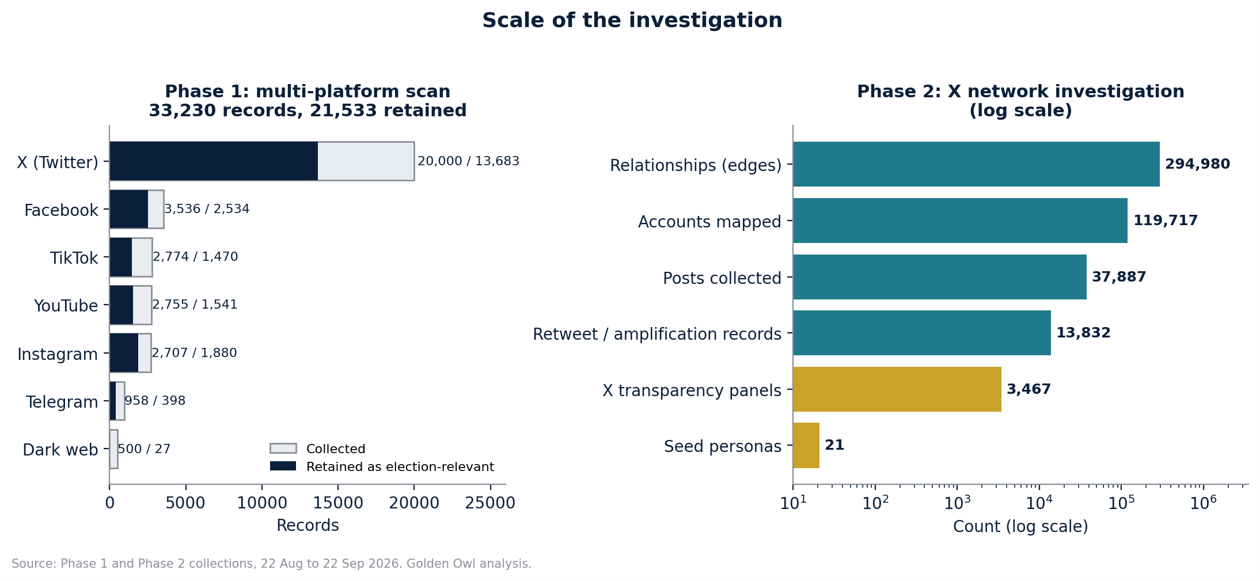
Figure 1. Scale of the two research phases. Left: records collected and retained per platform in Phase 1. Right: objects collected in the Phase 2 network investigation (logarithmic scale).
The two phases form a single analytical sequence. Phase 1 mapped the election conversation and surfaced the anomalies within it: false election information, foreign framing of the vote, anomalous accounts and influence capabilities offered for sale. Phase 2 followed those anomalies from content to the accounts and relationships behind them, which is where the coordinated network comes fully into view.
3. Methodology and Scope
This investigation began with a broad and politically neutral research question: whether publicly observable activity surrounding Israel's 2026 election showed evidence of foreign information manipulation or interference directed at voters inside Israel. It did not begin by selecting a political candidate, party, ideological camp, narrative or presumed foreign perpetrator for investigation.
Between 22 August and 22 September 2026, Golden Owl processed 489,281 distinct data points across two analytical phases. The first phase collected 33,230 election-related records from seven public platforms and online environments in Hebrew, Arabic, English and Russian. Following relevance screening, 21,533 items were retained for analysis. The second phase examined the account and relationship structures associated with potentially coordinated activity on X, mapping 119,717 accounts, 294,980 relationships, 37,887 posts and 3,467 platform transparency records.
The initial dataset was assessed without regard to whether content supported or opposed any candidate or political position. Approximately 93 per cent of the retained election-related material was assessed as ordinary political activity. This material included criticism of candidates or public authorities, partisan accusations, allegations of misconduct, campaign slogans, expressions of anger, organised but transparent political advocacy, and disagreements between Israeli political groups. Such activity was not treated as evidence of foreign interference.
Public discussion of the election by foreign individuals, governments, news organisations or state media was also excluded from the definition of interference merely because it expressed an interest in the outcome, criticised one side, or appeared to favour a particular political position. Foreign commentary and state-media coverage were used only as contextual or comparative material. Narrative similarity, political alignment or criticism of the Israeli government was not, by itself, treated as evidence of coordination, foreign control or attribution.
The investigation focused specifically on evidence of deceptive and coordinated conduct intended to influence how voters within Israel perceived political actors, public institutions, security events or the legitimacy of the electoral process. Because intent cannot normally be observed directly from open sources, it was assessed from behaviour: the presentation of foreign-operated accounts as Israeli citizens, sustained targeting of Israeli audiences, coordinated amplification, copied material, synchronised account activity, concealed or misleading account histories, platform-published location and client information, and operational connections with previously documented influence assets.
The analysis proceeded in two stages. The first stage mapped the election conversation as a whole and established the baseline of authentic political activity. Only after this broad review did the second stage move from content to account and network analysis. That stage used the anomalous accounts identified in the first stage, together with previously documented influence assets, as evidentiary entry points and examined the surrounding relationships, rather than searching for accounts because they criticised or supported a particular candidate. Accounts were assessed through network expansion, platform transparency data, behavioural and linguistic analysis, duplicate-text detection, timing patterns, account-history review and comparison with relevant foreign state narratives.
No individual indicator was treated as proof. A foreign location, a recently created account, the use of artificial intelligence, political criticism, linguistic errors or narrative similarity could each have an innocent explanation. An account was included in the assessed network only when multiple independent indicators converged. Wherever the available evidence was insufficient or a plausible alternative explanation remained, the account was excluded or assigned a lower confidence level.
Accounts reasonably assessed as belonging to authentic individuals were not classified as members of the operation. Genuine users, journalists, political figures and campaign accounts may appear in the analysis as sources of public content, targets of persona activity or unwitting amplifiers. Their interaction with investigated content does not imply knowledge, coordination or participation. The investigation did not seek to identify the natural persons operating the assessed personas.
The combined evidence was most consistent with a foreign-operated influence network aligned with, and operationally connected to, assets previously attributed to the Islamic Republic of Iran. This assessment is based on the convergence of platform-attested Iranian client data, account and network relationships, content-transfer patterns, non-native linguistic indicators, coordinated behaviour and alignment with Iranian state narratives. It does not establish the identity of the human operators, the specific Iranian institution or contractor involved, or a payment or command chain. Those determinations would require platform-internal information or competent governmental intelligence beyond the scope of open-source research.
3.1 Confidence levels
Each assessment in this report is expressed with one of the following confidence levels:
|
Confidence |
Meaning in this report |
|
High |
Multiple independent indicators converge, at least one of them platform-attested or documentary. Alternative explanations were considered and are substantially weaker. |
|
Medium-high |
Strong convergent indicators, but a plausible innocent explanation cannot be fully excluded for every account. |
|
Medium |
Consistent indicators that warrant monitoring; not sufficient alone for attribution. |
|
Low |
Weak or single-source indicators; recorded for completeness. |
3.2 Platform data limitations
· Platform location labels are X's inference and can be affected by VPNs, travel or roaming. They are always combined with other signals. X assigns the broad label "West Asia" to many genuine Israeli accounts, including well-known journalists, and we do not treat that label as suspicious on its own.
· The Iranian app label shows which build of the X application an account uses. It is a strong operational indicator, but it does not by itself identify the operator or the sponsoring organisation.
· X no longer exposes lists of accounts that liked a post, so amplification is measured through retweets, quotes and replies.
· The second-hop expansion covered suspicious neighbours only. The network described here is therefore a lower bound.
4. Phase 1: anomalies in the election conversation
Phase 1 screened 21,533 election-relevant items for signs of manipulation. Against the baseline of ordinary political activity described in Section 3, it isolated 1,516 flagged anomalies: false information about the vote itself, foreign framing designed to delegitimise the election, accounts with anomalous identities and behaviour, pre-emptive claims that the result will be stolen, and influence capabilities offered for sale. Each anomaly class is described below. Together they defined the profile that Phase 2 followed into the account networks.
|
Anomaly class |
Items flagged |
|
False or misleading voting information (wrong dates, postponement, online voting) |
96 |
|
"Emergency to postpone the election" narrative |
87 from 78 authors |
|
Security events framed as "election theatre" (mostly Arabic, foreign outlets) |
625 from 439 authors |
|
Pre-emptive fraud allegations (of 357 fraud allegations in total) |
238 |
|
Suspicious actors |
237 |
|
Foreign-influence candidates |
57 |
|
Incitement or threats |
87 |
|
Hack-and-leak claims |
48 |
|
Impersonation of politicians, journalists or institutions |
21 |
|
Undisclosed synthetic media |
20 |
4.1 False election information: postponement claims and wrong dates
The most direct threat to an election is false information about the vote itself. Phase 1 flagged 96 items of false or misleading voting information across X, TikTok, Instagram, Facebook and Telegram. Many originate from accounts located outside Israel and are written in Arabic, Russian or English, targeting audiences who follow Israeli politics from abroad as well as Arabic speakers inside Israel:
|
Platform |
Account (X: based in) |
Claim |
|
X |
@BRany4443 (Yemen) |
"The upcoming Israeli elections of 27 October will be postponed by a month and a week", posted four times within minutes on 20 September |
|
TikTok |
@rona.bar6 |
"New law: the elections have been postponed. Taxes and mortgage payments frozen" |
|
|
Post DcWc2jjCOVC |
"The polling station is already open. Voting link in bio" (Israel votes only by paper ballot at polling stations) |
|
X |
@CitizenMediaVT (United States) |
The election will be "paused due to fraud and foreign interference", with "the machines and mail-in voting" stopped (Israel uses neither) |
|
X, Facebook |
@skndom_bot (Saudi Arabia, automated); Al Hadath |
An absentee-voting grievance about "600,000 Israelis abroad" being obstructed by Likud (Israel has no general absentee voting) |
|
X |
@Tamam3o (Yemen), @Mustapha69ma (Morocco), @GentileQueennie (United States, created August 2026) |
Election day given as 26 October |
|
X |
@eRlphaX (Nigeria), @drisssenhaji2 (Morocco) |
Election day given as 17 October, or as "next November" |
|
TikTok, Facebook |
@tomashevssky (Russian); Arabic Facebook page |
Election day given as 23 August 2026, or as 27 October 2027 |
The postponement theme runs alongside these claims. The narrative that an emergency will be used to postpone the election appeared in 87 items from 78 authors, half of them in Arabic, with peaks on 15 and 20 September.
4.2 Foreign framing of the vote as "election theatre"
Iranian, Houthi and Hezbollah-aligned outlets, together with Turkish, Qatari and Russian state voices, framed every Israeli security action as campaign theatre, in 625 items from 439 authors. Houthi broadcasters such as @TvAlmasirah (241,000 followers) and @ShahidAlmasirah described operations in Lebanon and Gaza as "election propaganda". The former Iranian ambassador @mojtaba_amaani wrote that Netanyahu detonated explosives "so that the sound of the blast would reach the ears of voters". The Iran-branded Arabic account @Irannow_ (18,811 followers, zero accounts followed) relayed Iranian officials alongside the claim that this may be "Israel's last election".
4.3 Anomalous accounts
Phase 1 placed 237 accounts on its suspicious-actor watchlist and 57 on its foreign-influence watchlist. Representative cases:
|
Account |
X: based in |
Anomaly |
|
@MoonFlight22 |
Europe |
122,643 posts at about 82 a day, no bio or location; attacks opposition leaders as "a failed opposition" while claiming to belong to their camp |
|
@GREATTRUMP13 |
Iraq |
Arabic campaigning for Likud inside Hebrew threads, casting the Israeli left as agents of foreign states |
|
@eurismar_e |
Indonesia |
Hebrew "poll results" written in the style of a leading Israeli political journalist (impersonation) |
|
@sawtieu |
France |
Arabic "news" brand created on 9 September 2026 with 7,572 followers and zero accounts followed |
|
@hadisdelfi |
United States |
Created June 2026; Iran-aligned Arabic messaging that Netanyahu "sells illusions to the Israeli public before the elections" |
|
@TNT_Media1 |
Yemen |
Created April 2026, 27,331 followers; machine-translated "revolt of the Zionist generals" video content |
|
@drdoeeu |
United States |
Created June 2026, about 172 posts a day, unverifiable academic credentials |
|
@JohnSmithdgmv |
Israel |
Created August 2026: "the left is the enemy... citizens will have to hunt the leftist enemy" |
4.4 Pre-emptive delegitimisation
The data contained 357 allegations of electoral fraud, 238 of them made before a single vote was cast and almost none offering evidence. The claims ran in both directions, with spikes on 17 September around a Supreme Court ruling on election-day monitoring. On 9 September, a statement branding a Haaretz report, a named journalist and the opposition as part of a foreign plot produced the largest narrative spike in the dataset. Persian Gulf and Levant outlets translated it into Arabic within hours. This climate is the terrain the persona network exploits: its accounts tell Israelis in advance that a defeat for their camp would mean fraud or a manufactured war.
4.5 Capabilities offered for sale
Dark-web collection identified the supply side of influence operations aimed at Israel:
· Telegram accounts registered to Israeli phone numbers, sold in bulk in ready-to-use session formats.
· SMMTG.PRO and similar services selling Telegram subscribers, boosts, votes and views in more than 20 countries, including Israel-targeted subscribers.
· A listing titled "Database elector.co.il", the domain of the voter-management app used by Likud, on the DarkNetArmy forum.
· Advertised datasets including a "Facebook database of four million Israelis", "Israel government phone numbers" and Israeli election data from 2020 and 2021.
4.6 From anomalies to networks
The election scan flagged 237 suspicious accounts and 57 foreign-influence candidates, providing leads for a deeper investigation. Golden Owl began the account and network phase with 21 anomalous seed personas. By mapping their followers, the accounts they followed, their amplifiers, shared content and platform transparency records, Golden Owl identified 1,170 suspicious neighbouring accounts for further expansion. This progression—from anomalies in election data to relationships between accounts—exposed the wider network examined in the following sections.
5. Entry points: the first anomalies
Phase 2 began from accounts that Golden Owl's own analysis flagged as anomalous: repurposed account histories, identities contradicted by platform location data, reciprocal follows with newly created accounts, templated output and systematic self-amplification. Background checks on those accounts then showed that several also appear in public reporting on foreign influence targeting Israelis. That record corroborates the anomalies Golden Owl detected. The investigative question was what surrounds them.
5.1 "Yaara Shalev" (@yaarashalev)
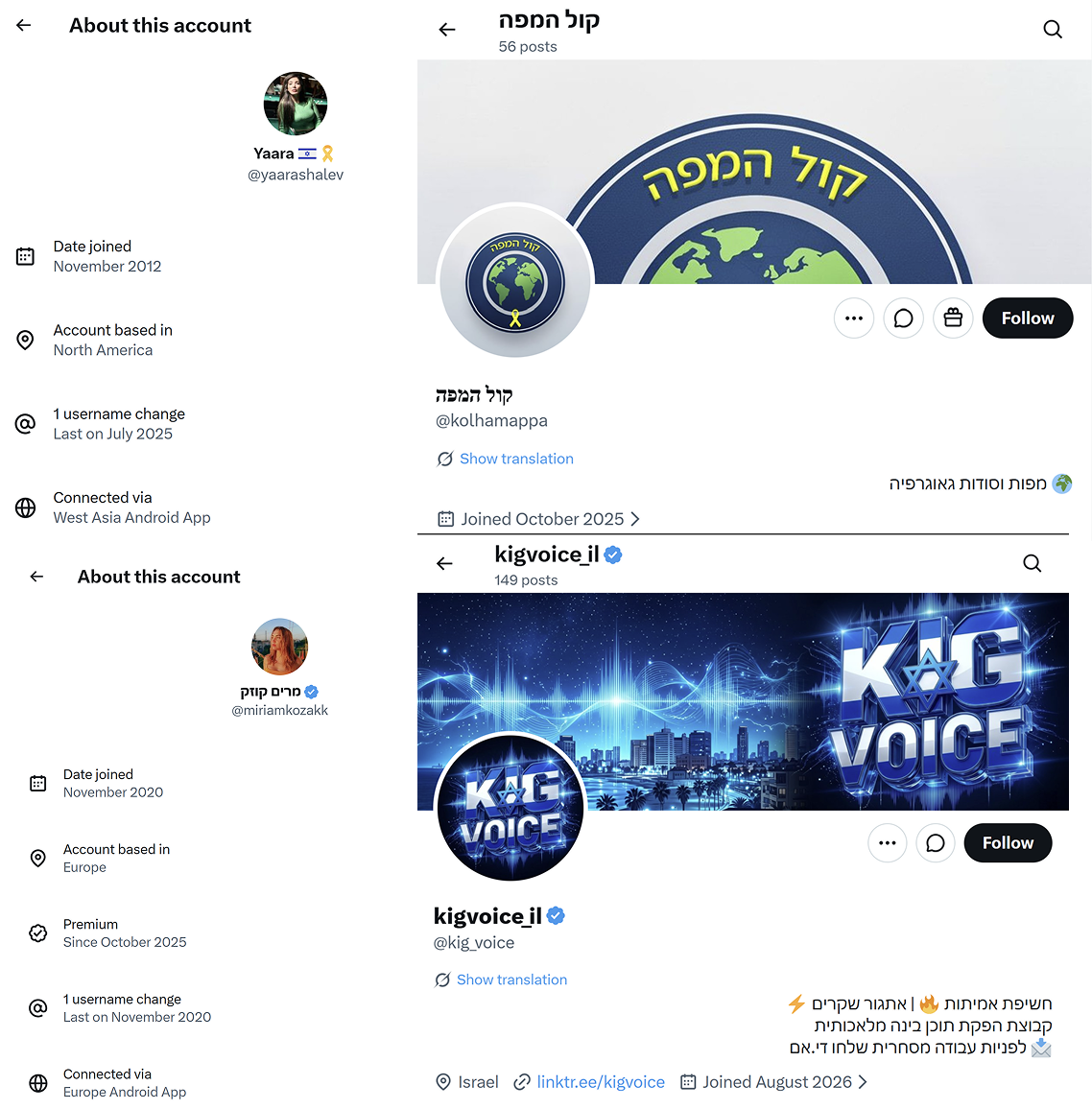
Golden Owl's analysis flagged @yaarashalev as an anomaly on its own indicators. The account presents as "Yaara", a Jewish Israeli woman who "believes in democracy" and "dreams of peace", yet it was created in November 2012 and carries only about 1,046 lifetime posts. Its username was changed on 29 July 2025, after which a daily political video operation began. X's transparency panel places it in "North America", flags that label as potentially inaccurate, and records a connection through the West Asia build of the Android app. When users questioned where it posts from, it answered four times with the same templated line: "When you support the Haredim, VPN probably sounds like science fiction to you. Not everyone who writes from somewhere else is really there." It follows back accounts with three to twenty-six followers, which is not how organic accounts discover one another.
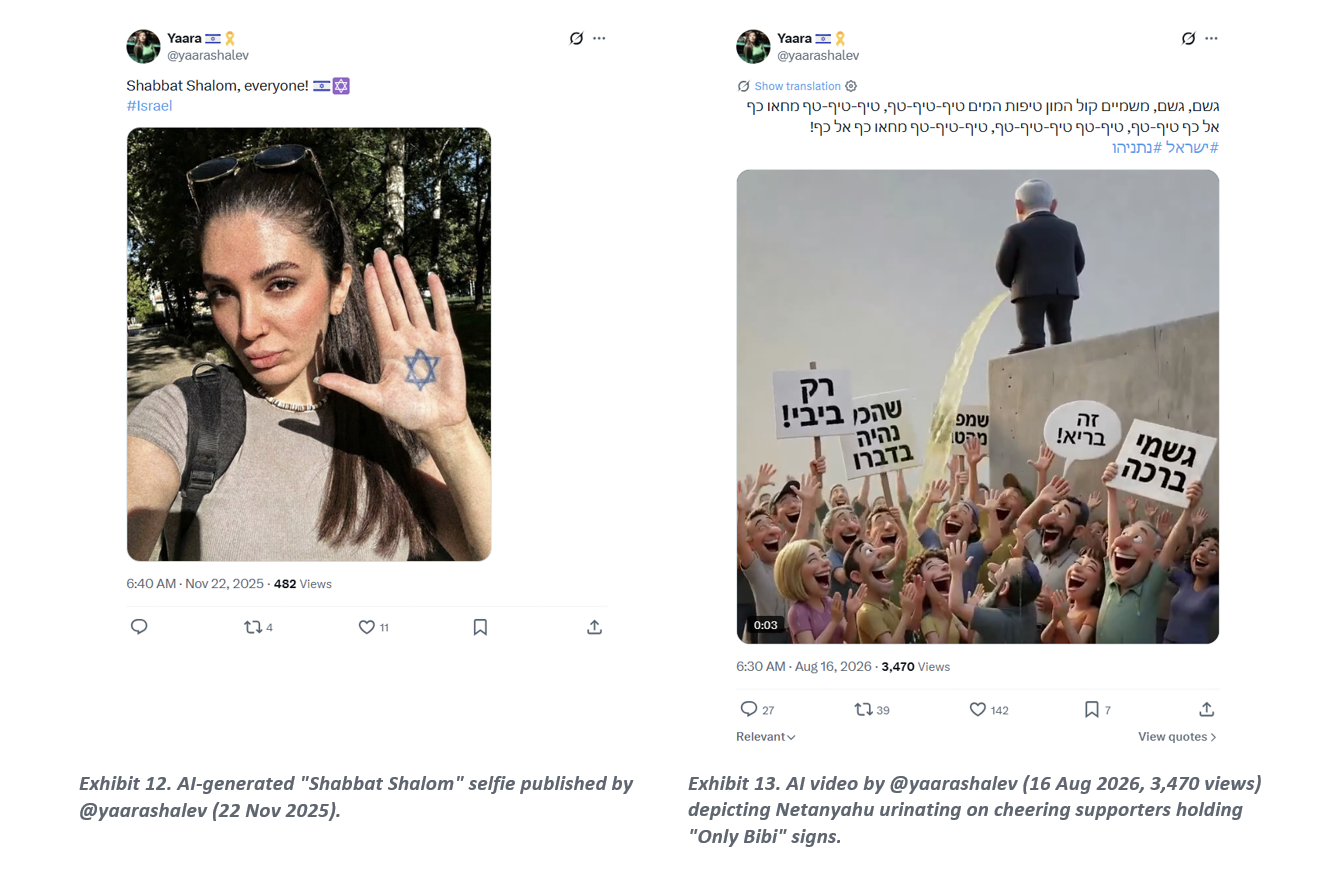
Golden Owl's background check across social platforms then showed that the persona's identity is assembled from borrowed and synthetic images. The photographs attached to the "Yaara" identity on different platforms are inconsistent: some trace to publicly circulated images of an adult-film performer, and others are AI-generated, including the "Shabbat Shalom" selfie examined in Section 11. The same background check found that the account had also been cited, in a March 2026 situation report by the Ministry for Diaspora Affairs and Combating Antisemitism, as an example of "persona-based engagement" in Iran's Hebrew-language influence campaign.
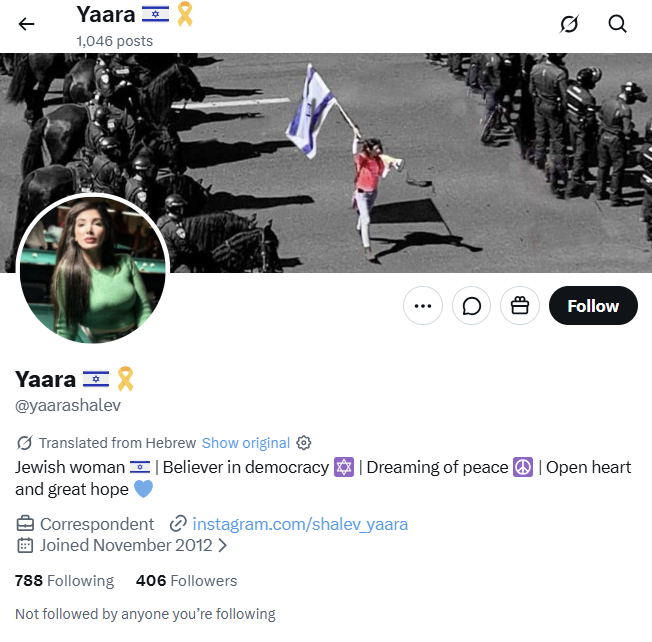
Exhibit 1. The @yaarashalev profile: an Israeli female persona with no verifiable biography, created in 2012 and repurposed in 2025, whose profile imagery is borrowed or synthetic.
Yaara functions as the network's content hub. It publishes near-daily vertical videos and graphics with a fixed hashtag block ("Israel, Netanyahu, Haredim, Equality" in Hebrew) and answers the companion personas each morning. Its most viewed post in our collection reached 688,434 views with the line "When violence becomes routine, leaving becomes the solution", an emigration message.
5.2 "Miriam Kozak" (@miriamkozakk)
"Miriam Kozak" surfaced in Golden Owl's network map as the operation's audience node, with 18,733 followers and an anomalous pattern of self-amplification: 53 of its 120 most recent items were retweets of its own posts, released in bursts of five to seven within two minutes. It declares "Israel" as its location, while X records it as based in Europe, connecting through a European Android build.
Background checks show a long record behind the persona. The Israeli watchdog FakeReporter exposed it as fictitious in January 2024, after it posted an AI-generated image of Netanyahu that genuine Israeli politicians then circulated as evidence of left-wing incitement. Later investigations described it as "a foreign-interference user, most likely Iranian" operating across Facebook, Instagram and X. During the 2022 election it pushed claims of Arab electoral fraud and anti-left messaging before switching to intense anti-Netanyahu content. In 2025 it created a Facebook group "supporting" MK Naama Lazimi that drew roughly 8,000 genuine Israeli members before Meta removed it following a press inquiry. Its Hebrew contained tell-tale errors, such as the calque "ידינו על הכתף שלכם" ("our hands are on your shoulder"), a phrase the X account also used.
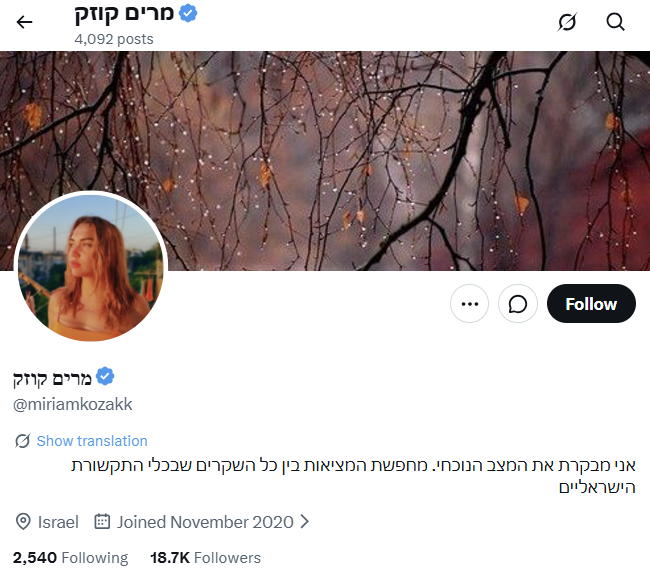
Exhibit 2. The @miriamkozakk profile declares "Israel"; X's transparency data records it as based in Europe. The persona was exposed by FakeReporter in 2024 and has been linked by investigators to Iran.
5.3 KigVoice and Kol Hamappa: the media-style channels
Tracing Yaara's follow and content relationships led to two Hebrew media-style channels, KigVoice and Kol Hamappa ("The Voice of the Map"). Both also appear among the "media-style channels" listed in the March 2026 government assessment. @kolhamappa was created in October 2025, is based in "West Asia", and is followed by @yaarashalev. It is mutual with @DaveActNow, the largest outside amplifier of the network, and with @KShavurOfficial ("Kol Shavur", "Broken Voice"), another Hebrew media-style channel that quotes it. @kig_voice was created on 5 August 2026, eighty-three days before the election. It posts short Hebrew captions over graphics and videos to an audience of nine followers. Its profile, now displayed as "kigvoice_il" with a paid verification mark and a declared location of "Israel", describes it as "an AI content production group" and invites commercial work. Section 6.2 shows where those captions go next.
|
EVIDENCE 1: Anchor personas and media-style channels
Left: X transparency panels for @yaarashalev (joined November 2012, based in North America, one username change in July 2025, connected via the West Asia Android app) and @miriamkozakk (joined November 2020, based in Europe, Premium since October 2025, connected via the Europe Android app). Right: the government-named channels Kol Hamappa (@kolhamappa, joined October 2025, "Maps and geographic secrets") and KigVoice (@kig_voice, joined August 2026), whose bio reads "Exposing truths | Debunking lies. An AI content production group. For commercial work, send a DM." Sources: x.com/yaarashalev/about | x.com/miriamkozakk/about | x.com/kolhamappa | x.com/kig_voice | www.gov.il/BlobFolder/reports/israel-and-us-strikes-in-iran-daily-status_2_3_26/en/mashlat_Roaring_Lion_israel-and-us-strikes-in-iran-daily-status_2_3_26.pdf |
6. Mapping the network
Starting from the anchor personas, the investigation mapped 119,717 accounts and 294,980 relationships. The operation is embedded inside that graph, among the journalists, politicians and engaged citizens whose conversations it enters. The analytical task was to separate the operation from the audience it targets. Figure 2 shows the evidential core: 70 accounts that the evidence places inside, or in direct operational contact with, the network.
The accounts shown in Figure 2 and examined in the following sections are a sample drawn from that dataset, selected because together they document every layer of the operation and every type of evidence. The total number of accounts associated with the network is substantially larger. All of them have been collected, mapped and retained in Golden Owl's dataset, together with their relationships and timelines. Section 6.3 sets out the scale of that wider footprint.
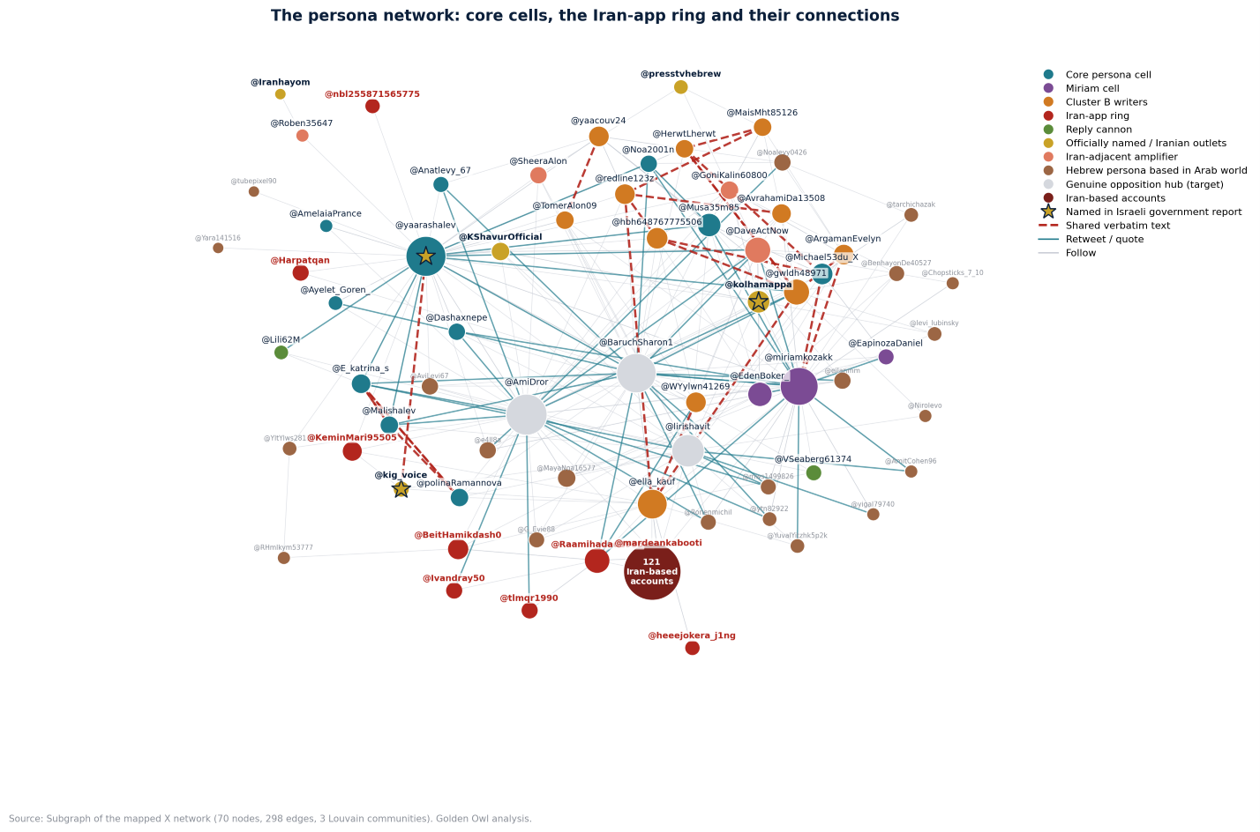
Figure 2. The persona network. Node colour shows the analyst classification, and node size shows connections within the subgraph. Red dashed lines mark verbatim shared text. Iran-app accounts carry a red outline, and gold stars mark assets named in the Israeli government report. The dark red node stands for the Iran-based and Iran-app accounts that the ring follows. Grey nodes are genuine opposition hubs that the personas target.
6.1 Five working layers
The network is not a single homogeneous cluster. It resolves into layers with distinct jobs, typing habits and technical fingerprints, bound together by follows, shared text and shared amplifiers:
|
Layer |
Accounts |
Function |
|
Core persona cell |
yaarashalev (hub), Malishalev, E_katrina_s, polinaRamannova, Michael53du_X, Musa35m85, Dashaxnepe, Noa2001n, Anatlevy_67, AmelaiaPrance, Ayelet_Goren_ |
Content hub plus companion personas that reply under Yaara's posts, quote her, and seed the same lines under large opposition accounts. Yaara follows back accounts with 3 to 26 followers. |
|
Miriam cell |
miriamkozakk, EdenBoker_, EapinozaDaniel |
Audience node (18.7k followers) fed by feeders with identical self-retweeting habits. Europe and Netherlands based. |
|
Cluster B writers |
gwldh48971, ella_kauf, HerwtLherwt, hbh648767775506, MaisMht85126, redline123z, AvrahamiDa13508, TomerAlon09, yaacouv24, ArgamanEvelyn, WYylwn41269 |
A second typing population (the " .. " separator) that shares text among itself and feeds lines forward to the core. Europe, North Africa, Lebanon and West Asia fingerprints. |
|
Iran-app ring |
Raamihadad1985, Ivandray50, tlmqr1990, mardeankabooti, BeitHamikdash0 |
Personas connected through the Iranian X app, bound by mutual follows and an identical tag-block signature, and bridged into the Miriam and core cells. |
|
Reply cannon |
VSeaberg61374, Lili62M |
High-cadence one-line replies under dozens of accounts. Registered 30 seconds apart with identical Romania / Ukraine-app fingerprints. |
Every seed is reachable from every other seed through follow edges. @yaarashalev is the structural centre: six of the first nine seeds follow it, and it follows six of them back. 1,255 accounts are linked to two or more of the 21 seeds, and the second-hop neighbourhoods of the suspicious accounts are markedly younger than the rest of the graph (Section 9).
6.2 The KigVoice pipeline: content supplied by a named Iranian channel
The most direct operational link in the dataset is a content pipeline. We compared every caption posted by @kig_voice, the X account of the KigVoice channel named in the government assessment, with Yaara Shalev's timeline. 14 of KigVoice's 40 collected posts (35%) reappeared as the caption or opening line of a later Yaara post.
· The direction never reverses. In every case KigVoice published first. The delay ranged from 9 to 68 hours, with a median of 29 hours. No Yaara post was later picked up by KigVoice.
· It is laundering by amplification. KigVoice's originals drew a combined 188 views. Yaara's republications of the same lines drew 13,077 views.
· It includes the election message itself. Yaara's most characteristic election slogans, "Your vote is your power" and "This year we choose differently", originated on KigVoice. So did her Qatargate line, "Money is stronger than any warning".
· It is sustained. The transfers run continuously from 30 August to 21 September 2026, roughly every one to three days, across topics including taxes, transport, Haredi exemptions and the election.
|
KigVoice posted (UTC) |
Caption (Hebrew) |
English |
Delay to Yaara |
Yaara views |
|
30 Aug 11:11 |
העלויות לא זהות לכולם |
The costs are not the same for everyone |
22 h |
1,560 |
|
04 Sep 09:29 |
רשות המסים תמיד יודעת איפה לחפש |
The Tax Authority always knows where to look |
32 h |
855 |
|
06 Sep 06:37 |
התחבורה מתוגברת |
Public transport is being 'reinforced' |
11 h |
1,152 |
|
09 Sep 12:09 |
תשתיות בישראל על מצב הישרדות |
Israel's infrastructure is in survival mode |
48 h |
264 |
|
10 Sep 15:40 |
חופשה שלהם פקק לכולם |
Their holiday, everyone's traffic jam |
37 h |
687 |
|
11 Sep 07:20 |
עד שהתור מגיע השיער כבר מלבין |
By the time your turn comes, your hair has gone white |
45 h |
1,843 |
|
11 Sep 11:34 |
השנה בוחרים אחרת |
This year we choose differently |
45 h |
1,380 |
|
13 Sep 07:41 |
הקול שלך הוא הכוח שלך |
Your vote is your power |
24 h |
312 |
|
14 Sep 11:23 |
תבחרו בעיניים פתוחות |
Vote with your eyes open |
18 h |
520 |
|
15 Sep 13:09 |
דמוקרטיה אבל עם יותר מדי גדרות |
Democracy, but with too many fences |
32 h |
157 |
|
17 Sep 10:22 |
החובה לא לכולם |
The duty is not for everyone |
68 h |
816 |
|
19 Sep 17:40 |
כשהברכה מגיעה מתקציב המדינה |
When the blessing comes from the state budget |
26 h |
399 |
|
20 Sep 13:48 |
הכסף חזק יותר מכל אזהרה |
Money is stronger than any warning |
16 h |
1,666 |
|
21 Sep 12:18 |
דילמות בלי סוף |
Endless dilemmas |
9 h |
1,466 |
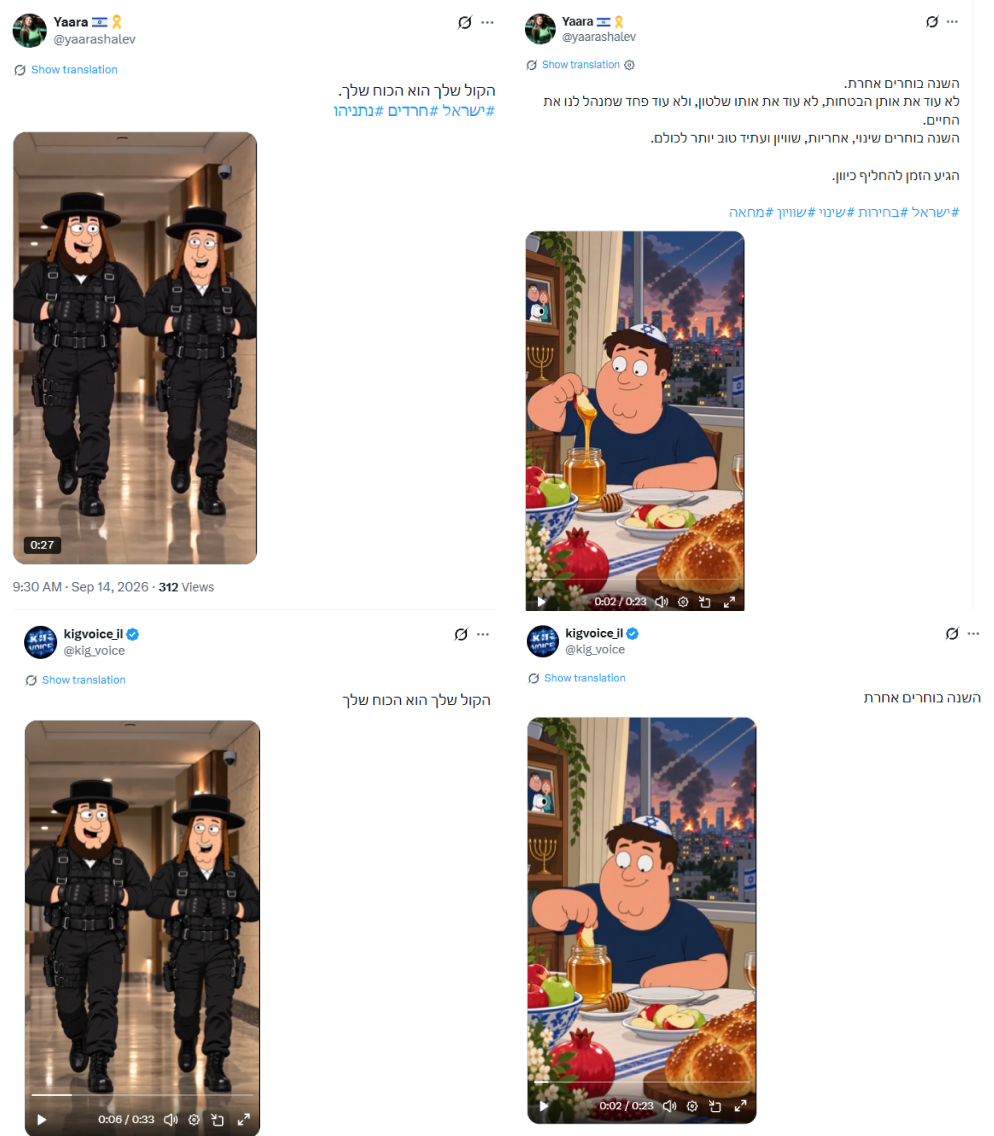
An ordinary activist who admired a nine-follower account might share its posts occasionally, with attribution. What we observe instead is systematic, unattributed republication of a named Iranian channel's captions as the persona's own words, within a day or two, for weeks. In the transfers captured in Evidence 2, Yaara republished not only KigVoice's caption but the same AI-generated video. The evidence shows that KigVoice and Yaara Shalev draw on the same content supply, with KigVoice acting as a staging channel and Yaara as the persona that carries the material to Israeli audiences. We assess this link with high confidence.
|
EVIDENCE 2: KigVoice captions republished by Yaara Shalev
Two of the fourteen transfers. Bottom: the KigVoice originals, "Your vote is your power" and "This year we choose differently", each posted with an AI-generated cartoon video. Top: the same videos republished by @yaarashalev under the same captions as her own posts (the first displayed 312 times on 14 September), extended with her election text and hashtag block. Sources: x.com/kig_voice/status/2099040839712301092 | x.com/yaarashalev/status/2099400253417910337 | x.com/kig_voice/status/2098374698597830740 | x.com/yaarashalev/status/2099057311461384350 |
6.3 The wider footprint
The personas and channels documented in this report form the evidential core of the operation, and the accounts named here are a representative evidentiary sample selected for publication. The network extends well beyond them. Applying the same indicators across the full mapped graph yields a layered footprint of accounts that belong to the operation, are connected to it, or operate alongside it in the same Iran-linked environment:
|
Layer |
Accounts |
Basis |
|
Classified personas and media-style channels |
35 |
32 personas and 3 Hebrew media-style channels, each supported by multiple convergent indicators |
|
Hebrew-presenting accounts based outside Israel and linked to the core |
192 |
Platform location outside Israel; 48 in countries with no plausible Israeli diaspora, 23 of them in the Arab world |
|
Accounts based in Iran or connecting through the Iranian app |
121 |
Platform-attested; 86 connect through the Iranian build of the X app |
|
Accounts with hard Iran indicators |
157 |
Iranian location or client, direct relations with Iranian outlets, or the ring's tag-block signature |
|
Recently created accounts with anomalous features around the personas |
418 |
Created in 2025 or 2026 and linked to the personas; 89 linked accounts with recent handle changes |
|
Accounts linked to the personas and based outside Israel |
883 |
Platform transparency records |
|
Suspicious neighbouring accounts expanded for second-hop analysis |
1,170 |
Recently created, very low follower counts, or an unexpected platform location |
|
Accounts connected to two or more personas |
1,255 |
Shared follows, retweets and quotes |
|
Accounts carrying Iran-related indicators |
2,645 |
Includes 2,172 profiles written in Persian script |
|
Accounts created in 2025 or 2026 in the neighbourhoods of suspicious accounts |
23,970 |
20% of the second-hop graph, against 8% among the personas' direct neighbours |
The layers overlap and carry different levels of confidence, so they are not presented as a count of operated accounts. Together they show the scale of the environment in which the personas operate: a coordinated core embedded in a far larger layer of foreign-based, recently created and Iran-connected accounts reaching into the Israeli election conversation. Golden Owl holds the complete account lists, relationship data and timelines for every layer. They extend well beyond the examples published in this report.
7. Operated from Iran: the Iran-app ring
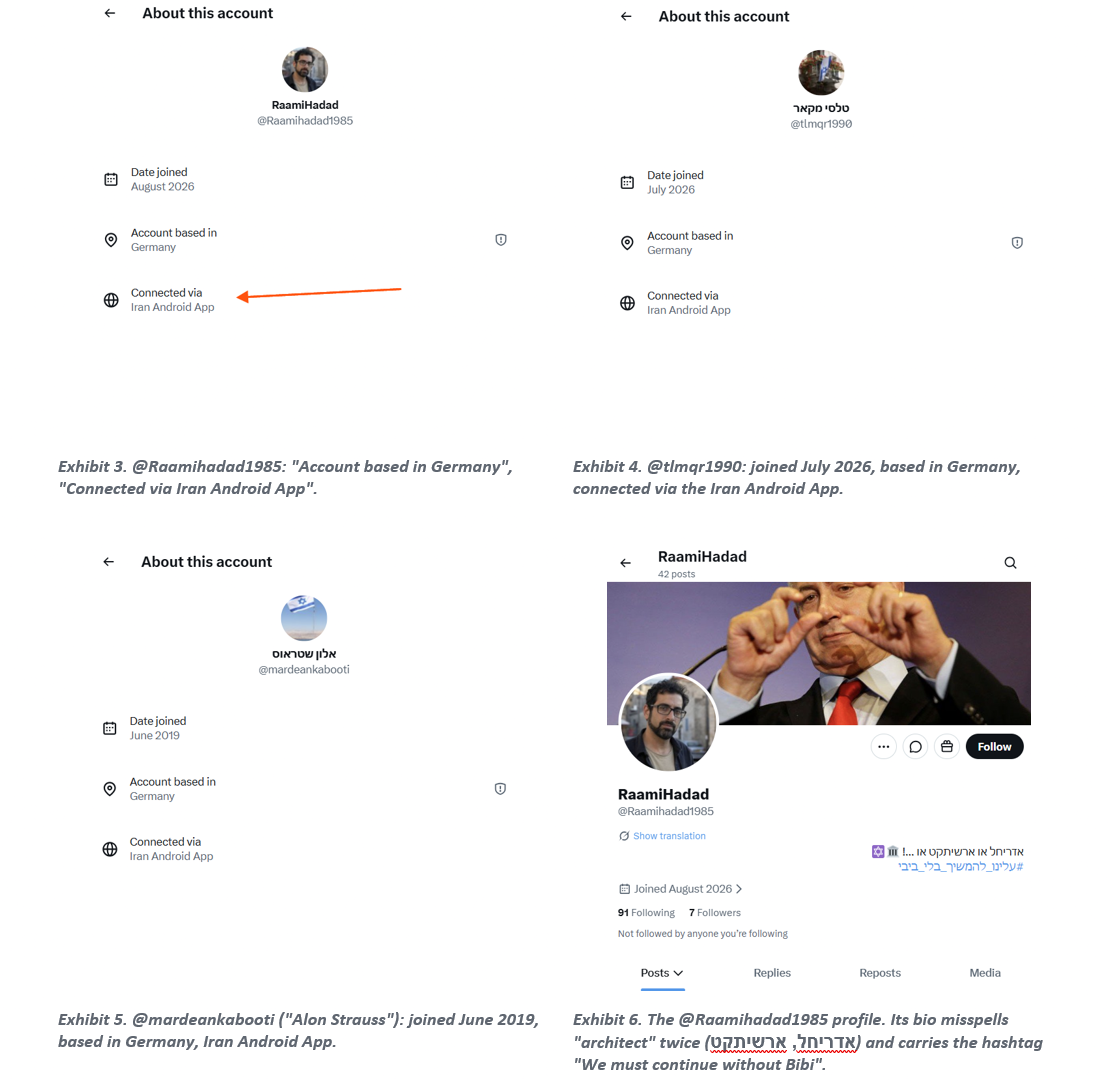
X's transparency panel records, for each account, the client build it connects through. For most Israeli users this reads "Israel Android App" or "Israel App Store". For four of the personas in this network it reads "Iran Android App". That is X's own label for the Iranian regional build of its Android application.
|
Account |
Persona |
Created |
Followers |
X: based in |
X: connected via |
|
@Raamihadad1985 |
"RaamiHadad", a self-described architect |
19 Aug 2026 |
6 |
Germany |
Iran Android App |
|
@Ivandray50 |
"Ivan Derai", a woman "for human freedom" (Arabic and Hebrew bio) |
6 Aug 2026 |
11 |
Finland |
Iran Android App |
|
@tlmqr1990 |
"Talsi Makar", an LGBTQ and Democrats supporter |
26 Jul 2026 |
10 |
Germany |
Iran Android App |
|
@mardeankabooti |
"Alon Strauss", an Israeli-flag avatar |
14 Jun 2019 |
18 |
Germany |
Iran Android App |
All four present as Israelis, post in Hebrew about the election, and are geolocated by X to Germany or Finland. Three were created in the three months before the election. The combination of a European location label with an Iranian client build is what one would expect from operators inside Iran reaching X through European VPN exit points or proxies, a common arrangement given that X is blocked in Iran. It is not what one would expect from Israeli expatriates.
7.1 "Alon Strauss" used to write in Persian
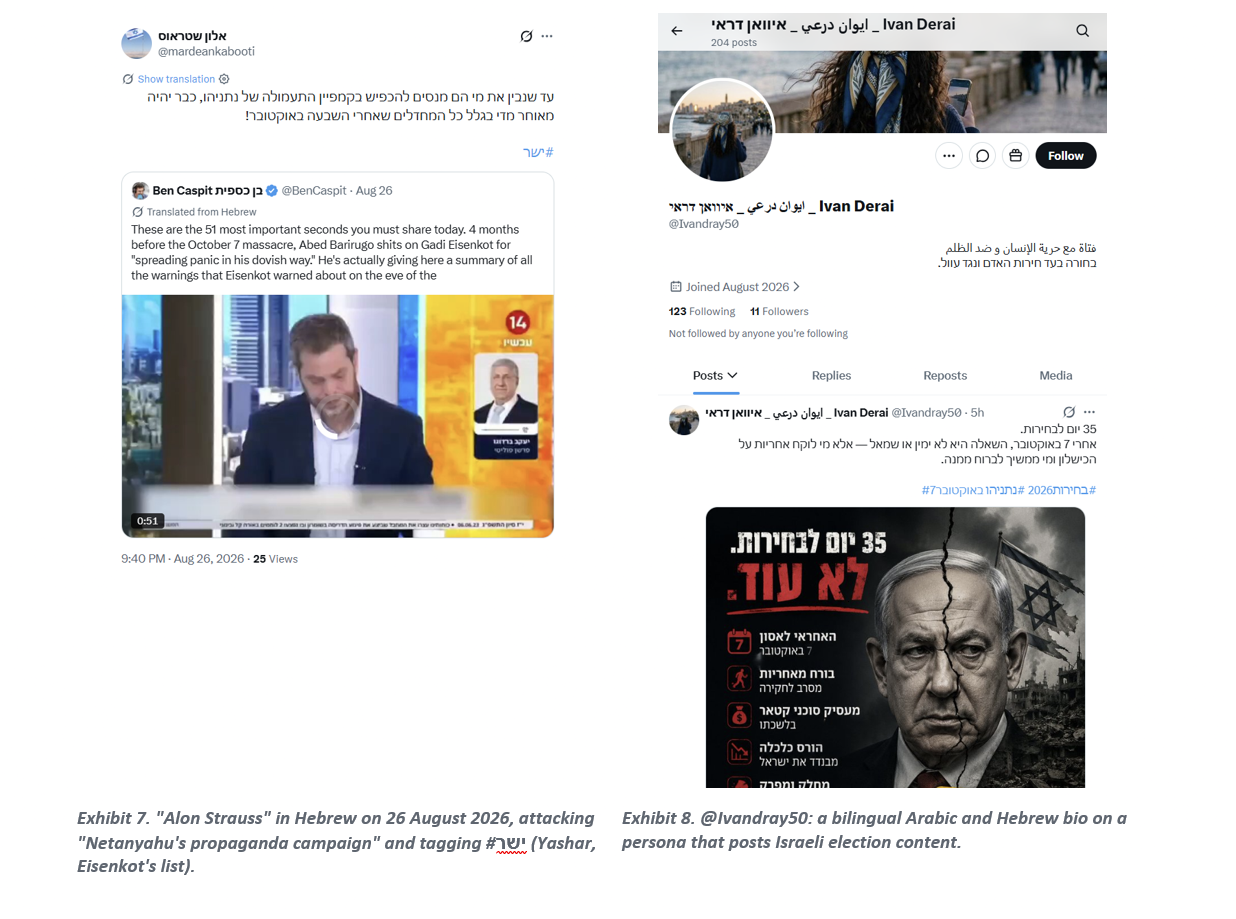
The clearest case is @mardeankabooti. The handle is Persian, mard-e ankabooti, meaning "Spider-Man". The account was created in 2019, and until April 2026 it posted exclusively in Persian, arguing with other Iranian users about Khamenei and Iranian politics. Its last Persian-language posts in our collection date from April 2026. On 26 August 2026 it re-emerged as "Alon Strauss", with an Israeli flag as its avatar, posting Hebrew hashtags for The Democrats and Yair Golan and calling Netanyahu "the most disgusting animal in nature".
Its following list tells the same story. Among the accounts it follows, 114 carry hard Iran signals: they are based in Iran, use the Iranian app, or are tied to Iranian outlets. They include Foreign Minister Abbas Araghchi, former Foreign Minister Javad Zarif, Yousef Pezeshkian (the President's son and adviser), Khamenei news accounts, an account dedicated to the late President Raisi, and Iranian journalists and clerics. Its followers include accounts located in Tehran. This is an Iranian user's account, rebranded as an Israeli voice nine weeks before the election.
7.2 A signature only this ring uses
Three of the Iran-app personas (Raamihadad1985, tlmqr1990 and mardeankabooti) append the same block of eight political handles, in the same order, to their posts: @gadi_eisenkot @naftalibennett @Israelzari @EitanGinzburg @YoraiLahav @yairlapid @meretzparty @HavodaParty. Across the 119,717 accounts in our graph, no other account uses this block. Two of them also share an identical block of Democrats hashtags. The ring is bound by mutual follows: Raamihadad1985 follows tlmqr1990, Ivandray50 and mardeankabooti and is followed back by all three. It is also mutual with @BeitHamikdash0, a right-wing "Temple Mount" persona created on 2 August 2026, which is discussed in Section 12.
7.3 "Ivan Derai" addresses "our Israeli people" in Arabic
@Ivandray50 writes Hebrew election content, including a designed "35 days to the election. No more." poster listing Netanyahu as "responsible for the disaster", "employer of Qatari agents" and "destroyer of the economy". It also slips into Arabic. Replying to an account, it wrote the same blessing twice, first in Arabic ("God bless them for their efforts to show the truth to our Israeli people who are being deceived") and then in Hebrew. It ends a Hebrew sentence with the Arabic question mark "؟". It posted within ten minutes of @VSeaberg61374 fifty times and of @miriamkozakk twenty-nine times.
|
بارك الله فيهم و بجهودهم لإظهار الحقيقة لشعبنا الإسرائيلي المضحوك عليه “God bless them and their efforts to reveal the truth to our Israeli people, who are being deceived. (The same sentence, written first in Arabic and then in Hebrew.)” @Ivandray50, 15 September 2026 |
7.4 How the ring connects to the rest of the network
· @Raamihadad1985 follows and retweets @miriamkozakk, replies to @Michael53du_X, and follows @ella_kauf, a Cluster B writer who is also followed by @mardeankabooti.
· @ella_kauf follows @VSeaberg61374, @miriamkozakk and @DaveActNow (the Press TV Hebrew follower and top amplifier), and is mutual with @heeejokera_j1ng, an Iran-app account.
· @KeminMari95505 (created March 2026, based in Germany, Iran Android App, 0 posts, 699 followed accounts) follows both @yaarashalev and @ella_kauf.
· @Harpatqan (Persian-language posts, United States label, Iran Android App) and @nbl255871565775 ("آنابل", United States label, Iran Android App) follow @yaarashalev.
· @heeejokera_j1ng ("Teddy Daniels", location "tehran !", Netherlands label, Iran Android App) posts in Persian about Iranian clerics.
7.5 Adjacency to Iranian state outlets
Beyond the app build, a targeted scan of the graph found 2,645 accounts with at least one Iran indicator and 157 with hard indicators, meaning platform-attested Iranian location or client, or direct relations with Iranian outlets. 121 accounts in the graph are based in Iran or use the Iranian app, 86 of them through the Iranian app, including the Iranian officials, state journalists and clerics followed directly by "Alon Strauss". The network's relations to Iranian Hebrew-language outlets are these:
· @yaarashalev follows @kolhamappa, the government-named channel.
· @DaveActNow, the single largest outside amplifier of the network (17 retweets of Yaara, 5 of Miriam), follows @presstvhebrew (Press TV's Hebrew service) and is mutual with @kolhamappa.
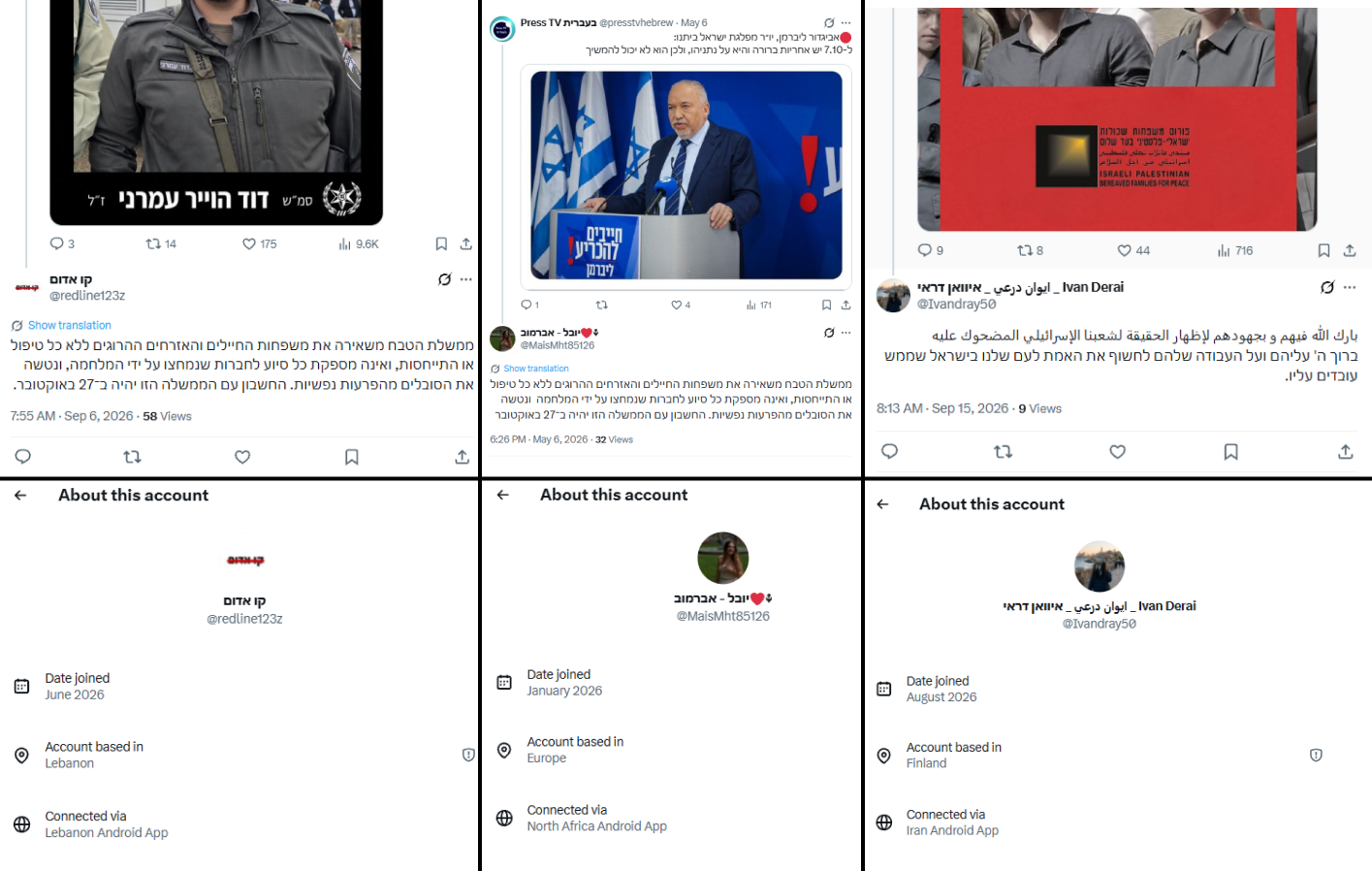
· @MaisMht85126 follows @presstvhebrew and replied to it on 6 May 2026. That exact reply text was reposted verbatim four months later by @redline123z, a Hebrew persona that X places in Lebanon.
· @Roben35647 (Europe label, West Asia app) follows @Iranhayom ("Iran Today", Iran's Hebrew outlet) and @yaarashalev.
· @SheeraAlon (Jordan Android app) follows @presstvhebrew and @yaarashalev. @GoniKalin60800 (Yemen Android app) is mutual with @kolhamappa and follows @yaarashalev.
· In March 2026, during Iranian missile attacks, @kolhamappa replied to @miriamkozakk: "Total victory, and now 50 dead in Shoham, thanks for the perfect defence Bibi". That post drew 684 views, the channel's largest audience.
|
EVIDENCE 3: Iranian outlet links and Iran-app transparency panels
Left and centre: on 6 May 2026 @MaisMht85126 (joined January 2026, based in Europe, connected via the North Africa Android app) replied under a Press TV Hebrew post: "The massacre government leaves the families of fallen soldiers and civilians without any care...". On 6 September the same text was posted verbatim by @redline123z (joined June 2026, based in Lebanon, connected via the Lebanon Android app). Right: @Ivandray50 (joined August 2026, based in Finland, connected via the Iran Android App) addresses "our Israeli people" in Arabic and then repeats the sentence in Hebrew. Sources: x.com/MaisMht85126/status/2052062497335624071 | x.com/redline123z/status/2096477275302621660 | x.com/Ivandray50/status/2099743306158678217 | x.com/redline123z/about | x.com/MaisMht85126/about | x.com/Ivandray50/about |
8. "Israelis" who are not in Israel
X's transparency data allowed us to compare where each Hebrew-speaking persona claims to be with where the platform places it. Of the Hebrew-presenting accounts linked to the seeds, 192 are based outside Israel. Many of these are genuine: Israeli journalists abroad, expatriates in Europe and North America, and diaspora Jews. We classified those as diaspora-plausible and set them aside. 48 remained in countries with no plausible Israeli diaspora, and 23 of those are in the Arab world.
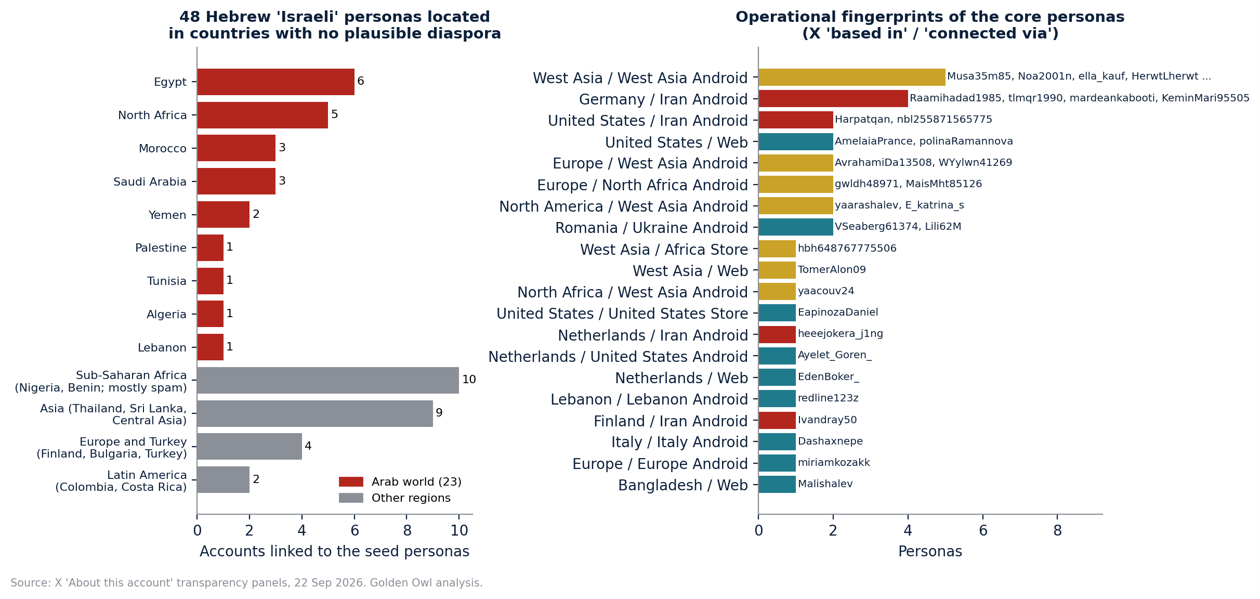
Figure 3. Left: Hebrew "Israeli" personas linked to the network, located by X in countries with no plausible diaspora. Right: the operational fingerprints (platform location and client build) of the classified personas. Red bars mark the Iranian app build.
Sub-Saharan and Southeast Asian entries include commercial spam (fake massage and "donation" bots) and some expatriates. We do not count them as evidence of the operation. The Arab-world entries are different in kind: they are fluent-looking Hebrew political personas with Israeli names and Israeli self-presentation, linked to the core accounts.
|
Account |
Presents as |
Claimed location |
X: based in |
Linked to |
|
@AviLevi67 |
"Avi Levi" |
Israel |
Egypt (3 handle changes) |
miriamkozakk, yaarashalev |
|
@Ronenmichil |
"Ronen Michaeli", a Maccabi fan |
ישראל (Israel) |
Egypt |
miriamkozakk |
|
@ytn82922 |
"Eitan Yosef" |
חיפה (Haifa) |
Egypt |
miriamkozakk |
|
@YuvalYitzhk5p2k |
"Yitzhak Yuval" |
ישראל (Israel) |
Egypt |
miriamkozakk, ella_kauf |
|
@eilanmm |
"Elian M.M.", 8,069 posts in a year |
תל אביב (Tel Aviv) |
Saudi Arabia |
Musa35m85, miriamkozakk |
|
@Chopsticks_7_10 |
"Correspondent" with Israeli emojis |
Israel |
Saudi Arabia |
miriamkozakk |
|
@AmitCohen96 |
"Amit Cohen", "honest, decent, right-wing" |
ישראל (Israel) |
Yemen |
miriamkozakk |
|
@mws1499826 |
"מוסא" (Musa) |
|
Yemen |
miriamkozakk |
|
@redline123z |
"Red Line", a "sarcastic stage for Israeli reality" |
|
Lebanon |
yaarashalev |
|
@MayaNoa16577 |
"Maya Noa" |
Israel |
Morocco |
miriamkozakk, yaarashalev |
|
@e4ll8a |
"Ella Ilani" |
Israel |
North Africa |
miriamkozakk, yaarashalev |
|
@yaacouv24 |
"Yaer Yaacouv", "I love the whole Land of Israel" |
Israel |
North Africa (West Asia app) |
yaarashalev, Musa35m85, gwldh48971 |
|
@Malishalev (seed) |
"Mali Shalev" |
USA |
Bangladesh |
yaarashalev |
|
@Dashaxnepe (seed) |
"Dasha" from Netanya |
Нетания (Netanya) |
Italy |
miriamkozakk, yaarashalev |
8.1 Shared fingerprints
Beyond single locations, identical combinations of location and client build recur across personas that also share text. That pattern indicates common operating infrastructure rather than coincidence:
· Europe / North Africa Android app: @gwldh48971 ("Galia Raz", "Israel") and @MaisMht85126 ("Yuval Abramov", "israel"), two Cluster B writers who share text with each other's circle.
· Europe / West Asia Android app: @AvrahamiDa13508 ("David Avrahami", "United States") and @WYylwn41269 ("Orit Aloni"), both of whom share verbatim text with other personas.
· Romania / Ukraine Android app: @VSeaberg61374 ("Vanessa Seaberg") and @Lili62M, registered 30 seconds apart on 18 May 2026 at 02:21 UTC. Both reply to and amplify Yaara.
· Germany / Iran Android app: three Iran-app ring members and @KeminMari95505.
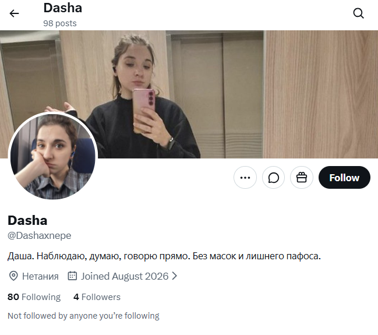
Exhibit 9. "Dasha" (@Dashaxnepe): a Russian-language bio and "Netanya" location on an account created in August 2026. X places it in Italy. It posts Hebrew political replies and once swore at another user in Russian.
|
EVIDENCE 4: Hebrew personas located in the Arab world and elsewhere
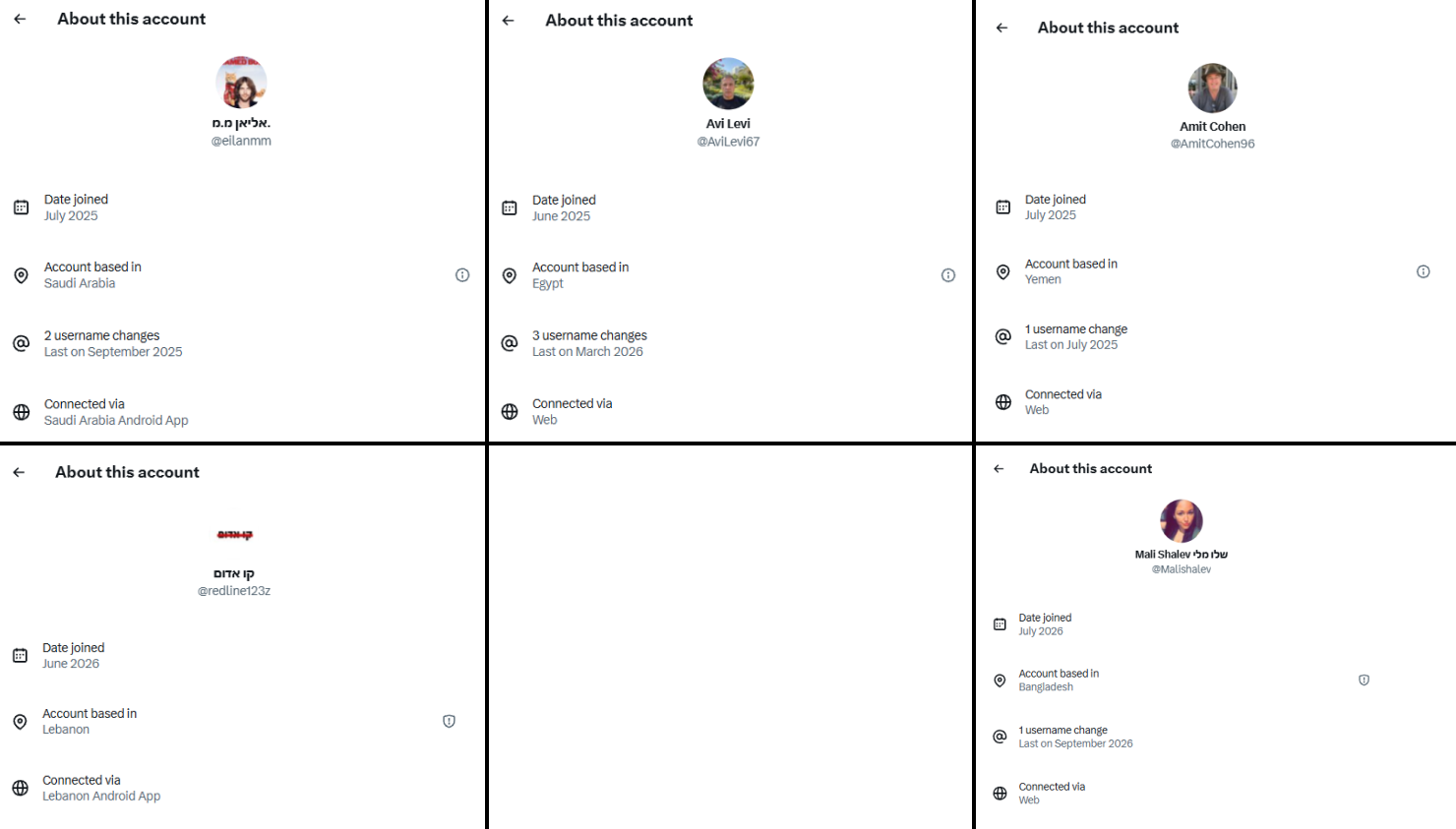
X transparency panels for Hebrew-language "Israeli" personas. Top: @eilanmm ("Elian M.M.", joined July 2025, based in Saudi Arabia, Saudi Arabia Android app, two username changes), @AviLevi67 ("Avi Levi", joined June 2025, based in Egypt, three username changes) and @AmitCohen96 ("Amit Cohen", joined July 2025, based in Yemen). Bottom: @redline123z ("Red Line", joined June 2026, based in Lebanon, Lebanon Android app) and @Malishalev ("Mali Shalev", joined July 2026, based in Bangladesh, username changed September 2026). Sources: x.com/eilanmm/about | x.com/AviLevi67/about | x.com/AmitCohen96/about | x.com/redline123z/about | x.com/Malishalev/about |
9. Manufactured freshness: new accounts and renamed shells
Influence operations need accounts, and accounts made for an election tend to be made shortly before it. Of the 32 classified personas, 26 (81%) were created in 2025 or 2026, and 19 in 2026. For comparison, only 11% of the 6,004 distinct X authors in the Phase 1 election conversation were created in that period. Among the seeds' direct neighbours the figure is 8%. In the second-hop neighbourhoods of the suspicious accounts it rises to 20%, or 23,970 accounts.
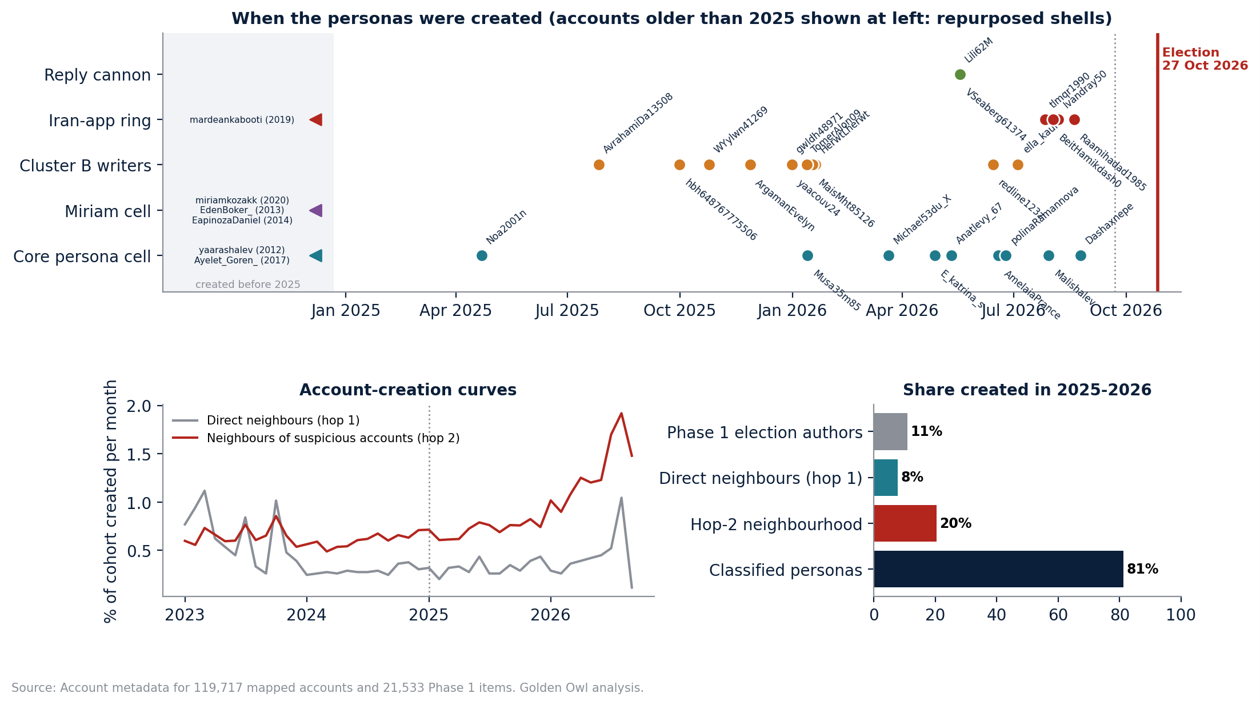
Figure 4. Top: creation dates of the classified personas against election day. Accounts created before 2025 are listed at left. Bottom left: monthly account creation in the direct and second-hop neighbourhoods. Bottom right: the share of accounts created in 2025 or 2026 in each population.
9.1 Coordinated renaming
Username changes are recorded by X with a timestamp. Several personas were renamed in ways that only make sense under common control:
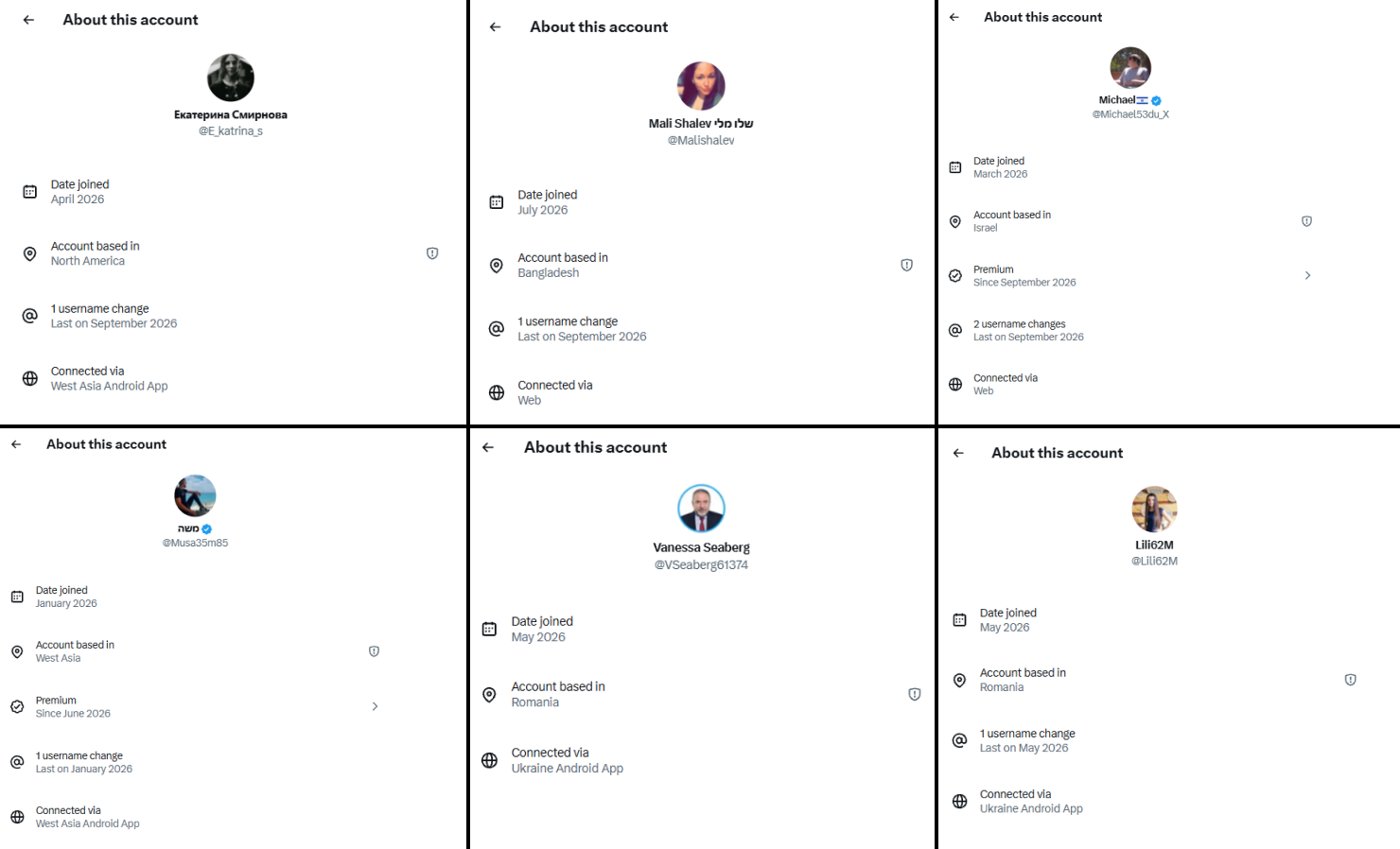
· @E_katrina_s (formerly @Nurten343732, a Turkish name, now "Ekaterina Smirnova") was renamed on 14 September 2026 at 07:31:41 UTC. @Malishalev was renamed the same morning at 07:42:32 UTC, eleven minutes later. The two accounts share ten verbatim texts.
· @Michael53du_X is the former @Eitan_X_, renamed on 6 September 2026.
· @Musa35m85 was created and renamed on the same day, 13 January 2026. @Anatlevy_67 changed handle twice on its creation day.
· @Ayelet_Goren_ is a 2017 account reactivated and renamed in May 2026. @EapinozaDaniel is a dormant 2014 account from Oregon that resumed in September 2026 with Hebrew image posts published on the hour, at 13:00, 15:00, 16:00 and so on (15 of 26 posts), which is the signature of a scheduler.
· @yaarashalev (2012) was renamed in July 2025. @mardeankabooti (2019) switched from Persian to Hebrew in August 2026.
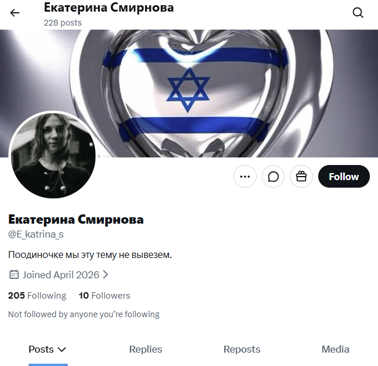
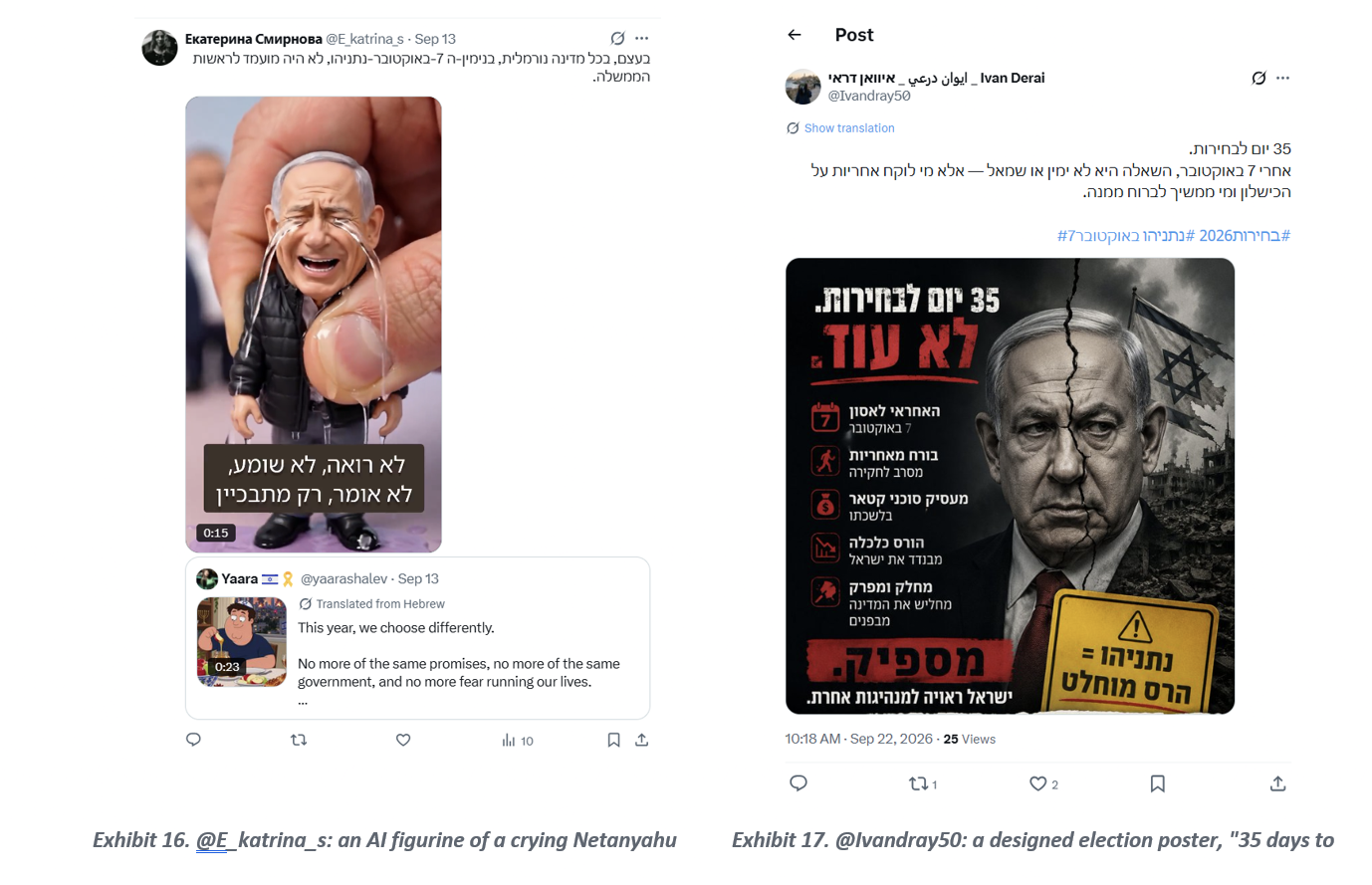
Exhibit 10. "Ekaterina Smirnova" (@E_katrina_s): created April 2026, formerly @Nurten343732. It writes Hebrew election replies using masculine first-person verbs under a female persona.
|
EVIDENCE 5: Account creation and handle-change records
Top: @E_katrina_s (joined April 2026, based in North America, connected via the West Asia Android app) and @Malishalev (joined July 2026, based in Bangladesh), both with a username change in September 2026, and @Michael53du_X (joined March 2026, two username changes, the last in September 2026). Bottom: @Musa35m85 (joined and renamed January 2026), and @VSeaberg61374 and @Lili62M, both joined May 2026, both based in Romania and both connected via the Ukraine Android app. The panels show months only; the exact timestamps cited in the text (renames at 07:31:41 and 07:42:32 UTC on 14 September, registrations 30 seconds apart on 18 May) come from the underlying transparency records. Sources: x.com/E_katrina_s/about | x.com/Malishalev/about | x.com/Michael53du_X/about | x.com/Musa35m85/about | x.com/VSeaberg61374/about | x.com/Lili62M/about |
10. One script, many voices
Independent people rarely publish identical paragraphs. We ran duplicate-text detection over 19,415 posts from 923 accounts in and around the network and found 67 cross-account matches (59 exact) across 33 account pairs. Once coincidental matches ("hahaha", greetings) are removed, the rest form a shared text library that moves between personas.
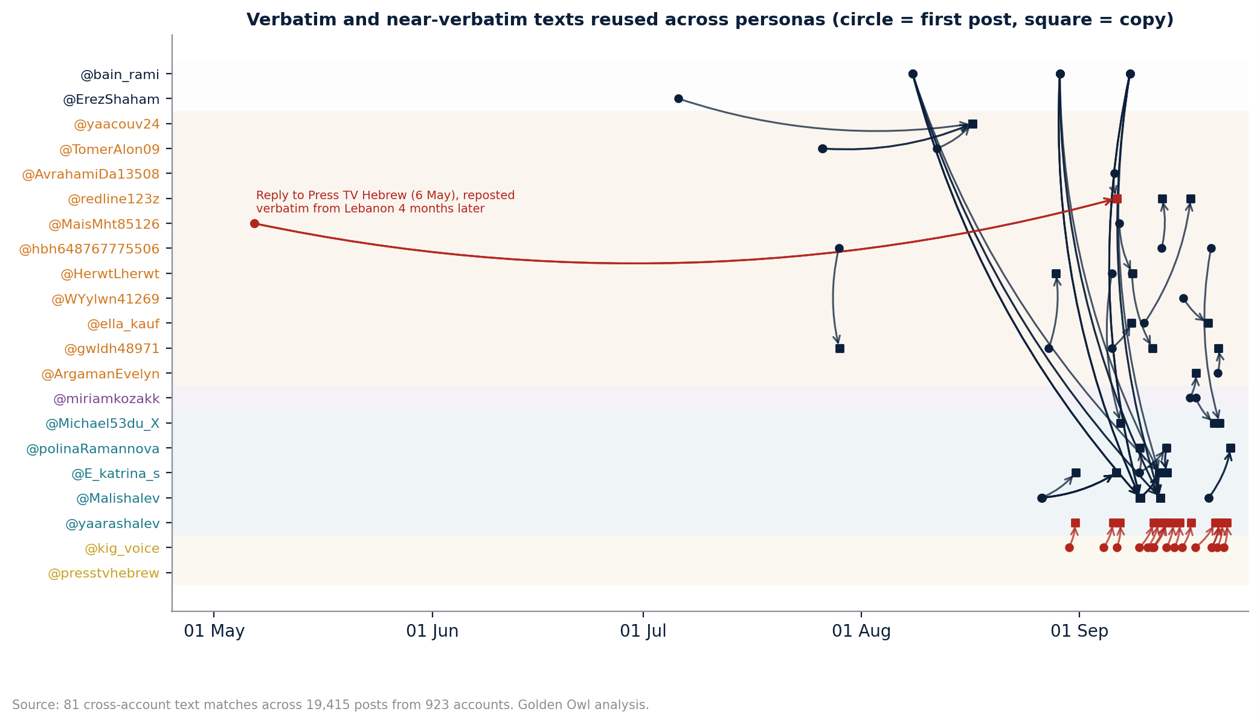
Figure 5. Verbatim and near-verbatim text moving between accounts over time. Each arrow runs from the first appearance to a later copy. Red arrows mark content originating with Iranian outlets: the Press TV Hebrew reply and the KigVoice caption pipeline.
10.1 What the library contains
|
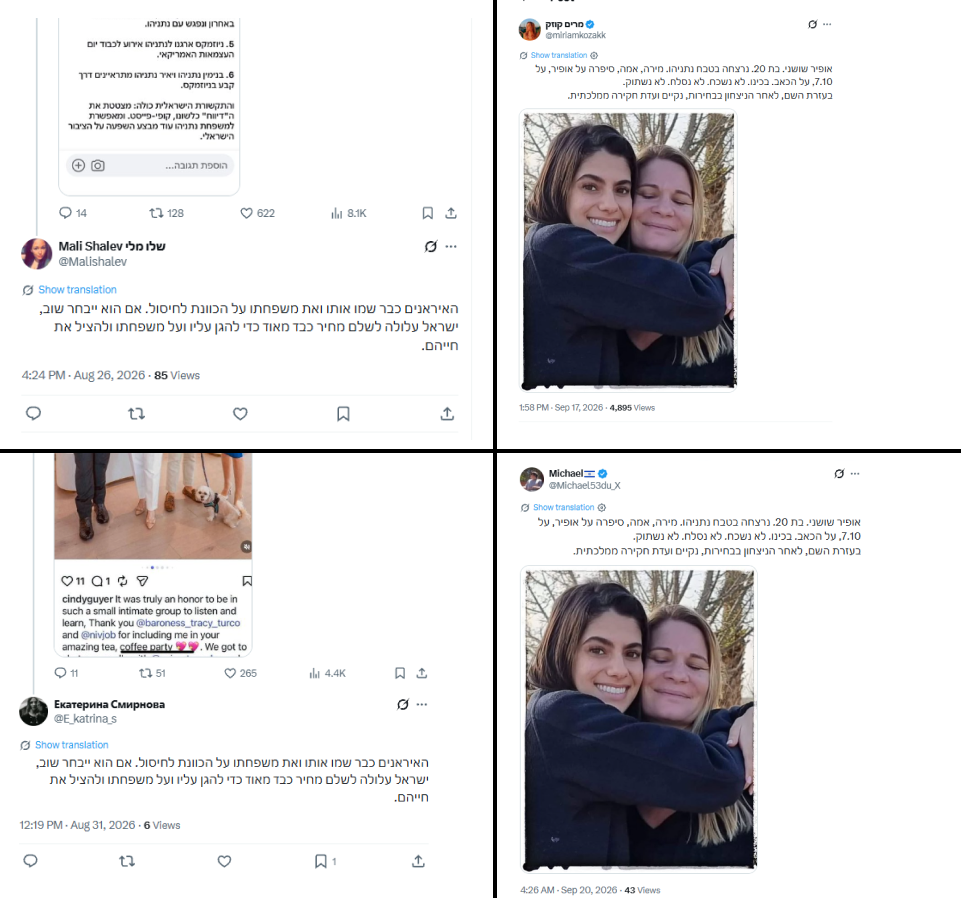
האיראנים כבר שמו אותו ואת משפחתו על הכוונת לחיסול. אם הוא ייבחר שוב, ישראל עלולה לשלם מחיר כבד מאוד כדי להגן עליו ועל משפחתו ולהציל את חייהם. “The Iranians have already put him and his family in their sights for assassination. If he is re-elected, Israel may pay a very heavy price to protect him and his family and save their lives.” Posted word for word by @Malishalev (26 Aug 2026) and @E_katrina_s (31 Aug 2026) |
The message deserves attention in its own right: an Iranian threat is used to argue that re-electing the Prime Minister would endanger Israelis. The two personas that published it were renamed eleven minutes apart and share nine further texts.
|
אופיר שושני. בת 20. נרצחה בטבח נתניהו. מירה, אמה, סיפרה על אופיר, על 7.10, על הכאב. בכינו. לא נשכח. לא נסלח. לא נשתוק. “Ofir Shoshani. Aged 20. Murdered in the Netanyahu massacre. Mira, her mother, told us about Ofir, about 7.10, about the pain. We cried. We will not forget. We will not forgive. We will not be silent.” @miriamkozakk (17 Sep; 4,881 views at the time of collection), republished verbatim by @Michael53du_X 62 hours later |
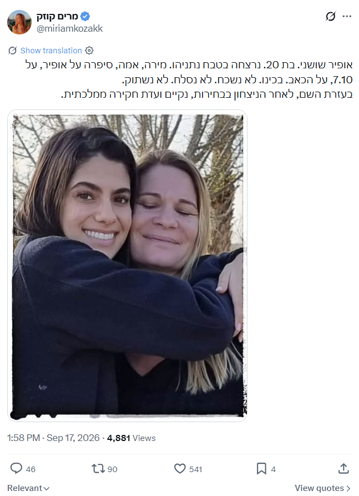
Exhibit 11. Miriam Kozak's post using a 7 October victim to brand the attack the "Netanyahu massacre". The identical paragraph appeared on @Michael53du_X 62 hours later.
|
First poster |
Copied by |
Gap |
Text (English) |
|
@MaisMht85126 (reply to @presstvhebrew) |
@redline123z (Lebanon) |
4 months |
"The massacre government leaves the families of fallen soldiers and civilians without any care..." |
|
@polinaRamannova (US label) |
@E_katrina_s |
45 min |
"In any normal country, Benjamin-the-7th-of-October-Netanyahu would not be a candidate for prime minister." |
|
@gwldh48971 |
@ella_kauf |
3 days |
"Whoever engineered the massacre and betrayed once, betrays always .." |
|
@ella_kauf |
@redline123z (Lebanon) |
6 days |
"Citizens, soldiers, the economy, education, everything pays the price of the betrayal that began 17 years ago." |
|
@HerwtLherwt |
@gwldh48971 |
3 days |
"There has never been such a terrible prime minister... 27.10, we will stop him." |
|
@hbh648767775506 |
@Michael53du_X |
29 h |
"After Netanyahu and his government transferred billions upon billions to draft-dodging parasites..." |
|
@TomerAlon09 |
@yaacouv24 (North Africa) |
3 weeks |
Three separate anti-Netanyahu replies copied in one evening. |
|
@kig_voice |
@yaarashalev |
9 to 68 h |
Fourteen captions (Section 6.2). |
One copied line exposes the copying mechanism. The insult "צאי לנו מהחיים חלאה" ("get out of our lives, scum") is grammatically feminine. It was first aimed by a genuine Israeli account at a female protest leader. @Malishalev and @E_katrina_s then pasted it, unchanged, under posts by male politicians. A native speaker adjusts the verb without thinking. A copy-paste operator working from a text bank does not.
10.2 Non-native Hebrew
Operators who type Hebrew on devices set up for Arabic or Persian switch between two right-to-left keyboards, and the switch leaves traces in the text. So do operators who learned Hebrew as a second language, or who rely on machine translation:
|
Artefact |
Example |
Account |
|
Arabic letters typed inside Hebrew words |
٤ממשלת · חוסر · المחדלים · لנכס (four posts) |
@Musa35m85 |
|
Arabic question mark ending a Hebrew sentence |
איפה המדינה באמת؟ ("Where is the state, really؟") |
@Ivandray50 |
|
The " .. " separator, an Arabic typing habit |
Present in the Cluster B writers; absent from Yaara (0 of 108 posts), Miriam and Musa |
@gwldh48971, @ella_kauf, @redline123z, @MaisMht85126 |
|
Gender agreement failures |
"Mali" calls Netanyahu "she" (ביבי תראה שהיא); "Ekaterina" writes "אני מציע" (masculine); "Ayelet" writes "אני גר" (masculine) |
@Malishalev, @E_katrina_s, @Ayelet_Goren_ |
|
Three genders in one sentence |
"אני ישראלית, אבל אני שונא ומתביישת" ("I am Israeli [f.], but I hate [m.] and am ashamed [f.]") |
@AmelaiaPrance |
|
Misspelling of basic words |
"אדריחל או ארשיתקט" ("architect" misspelt twice); "לדעכם" for "לדעתכם" |
@Raamihadad1985 |
|
Pagan idiom |
"בעזרת האלה" ("with the help of the goddess") in place of "with God's help" |
@Ayelet_Goren_ |
|
Look-alike characters |
Claimed location "lsrael" with a lowercase L |
@ArgamanEvelyn |
|
Foreign conventions |
Percent sign before the number ("%100"); « » guillemets |
@AmelaiaPrance, @Malishalev |
|
Unrelated foreign trending hashtags appended to Hebrew political posts |
#AyusoDimisión, #LaCasaDeLosFamososMéxico, #12Eylül1980, #Panamá |
@hbh648767775506, @gwldh48971, @redline123z |
|
EVIDENCE 6: Shared text across personas
Left: the identical paragraph "The Iranians have already put him and his family in their sights for assassination. If he is re-elected, Israel may pay a very heavy price..." posted by @Malishalev (26 August 2026, 85 views) and by @E_katrina_s (31 August 2026). Right: the Ofir Shoshani paragraph and photograph posted by @miriamkozakk (17 September, 4,895 views) and republished with the same text and image by @Michael53du_X (20 September). Sources: x.com/Malishalev/status/2092619179740324337 | x.com/E_katrina_s/status/2094369412115505249 | x.com/miriamkozakk/status/2100554964561014953 | x.com/Michael53du_X/status/2101498168722522276 |
11. Synthetic faces and synthetic outrage
Generative AI is now part of mainstream Israeli campaigning: parties across the spectrum publish AI videos, and Israeli law requires disclosure. What sets this network apart is how it uses AI: to fabricate the identity of the persona itself, and to mass-produce degrading imagery of the Prime Minister and his family for distribution through accounts that pretend to be Israeli citizens.
11.1 A synthetic identity
The "Shabbat Shalom" selfie that Yaara Shalev published in November 2025, showing a young woman with a Star of David drawn on her palm, is an AI-generated image. Our analysis attributes it to a commercial image generator (Google's Gemini). The image does what a persona needs: it gives a fabricated Israeli woman a face and a patriotic gesture.
11.2 The Netanyahu imagery factory
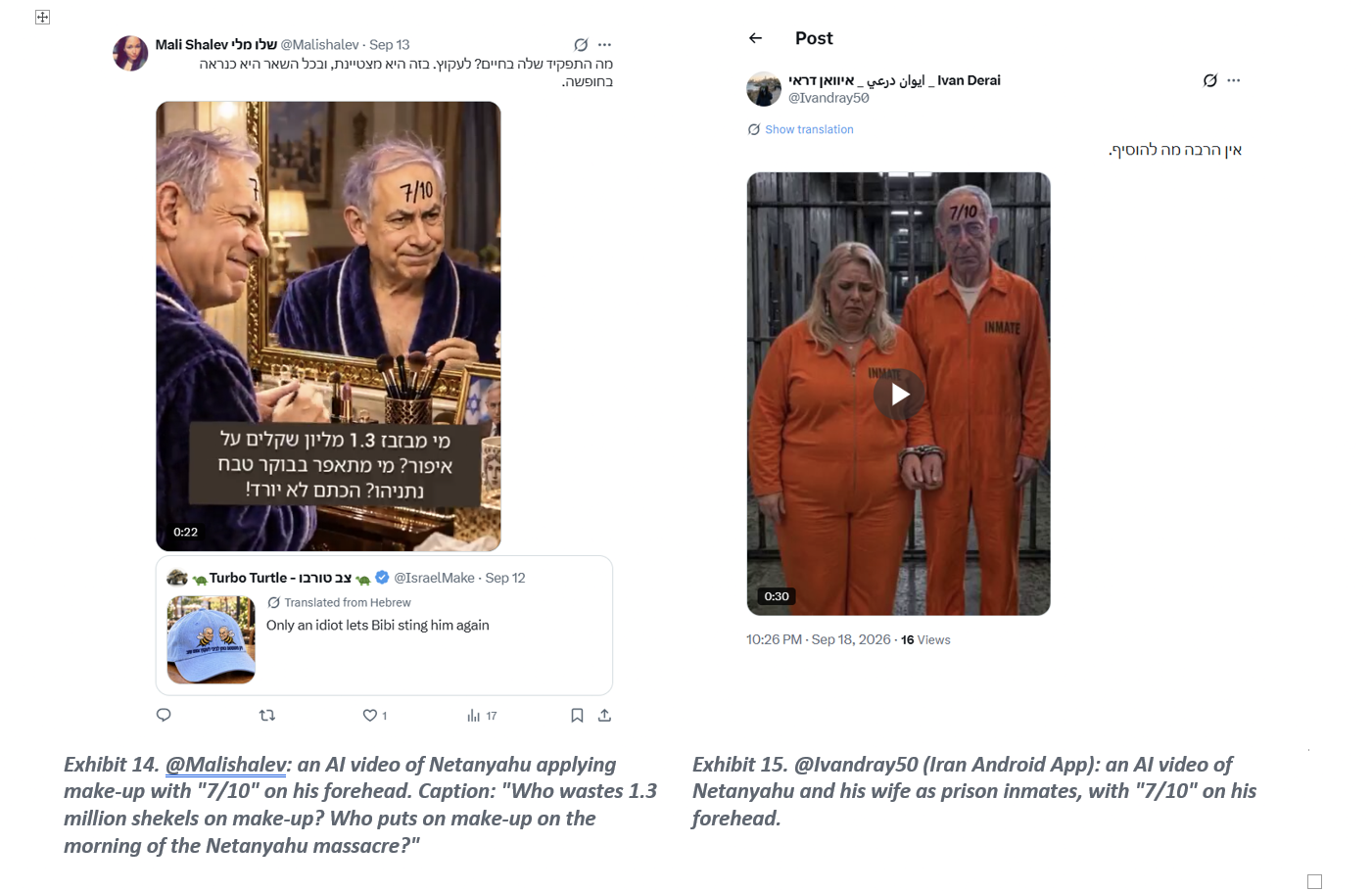
Across the network, AI video follows a consistent template: a realistic rendering of Netanyahu, often with "7/10" written on his forehead, placed in humiliating scenes with a Hebrew caption. The template recurs across personas that share text and followers:
11.3 Admissions and suppliers
· @MaisMht85126 replied to Netanyahu's account on 22 September: "I asked Gemini to create an image of a psychopathic, demented dictator in the twilight of his days", attaching the result.
· @Raamihadad1985 (Iran Android App) quote-posted AI content with "This is just one example of the content this small group produces with AI".
· @macho_man36, a US-based English-language hobbyist who labels his videos "Made with AI", offered his "Bibisitter" AI parody to Yaara Shalev: "I really love your cartoons. I wanted to share with you a video I recently made with AI." We assess macho_man36 as a probably genuine individual and exclude him from the network. The exchange still shows how a persona hub can source ready-made synthetic media from authentic users.
.png)
Exhibit 18. An AI video by @macho_man36, labelled "Made with AI" by X. The account offered similar content to Yaara Shalev and is assessed as a probably genuine user, not a network member.
12. One content model
The personas differ in persona, typing habits and infrastructure, but they publish the same argument. Read together, their output resolves into a consistent set of pillars that recur across every layer of the network, from the government-named hub to the Iran-app ring and the Arab-world personas.
12.1 Pillar one: 7 October as the "Netanyahu massacre"
The central claim is that Netanyahu is personally responsible for 7 October. It escalates from failure, to betrayal, to deliberate complicity. The phrase "טבח נתניהו" ("the Netanyahu massacre") and its variants, "ממשלת הטבח" ("the massacre government") and "גוש הטבח" ("the massacre bloc"), turn a national trauma into a personal indictment.
|
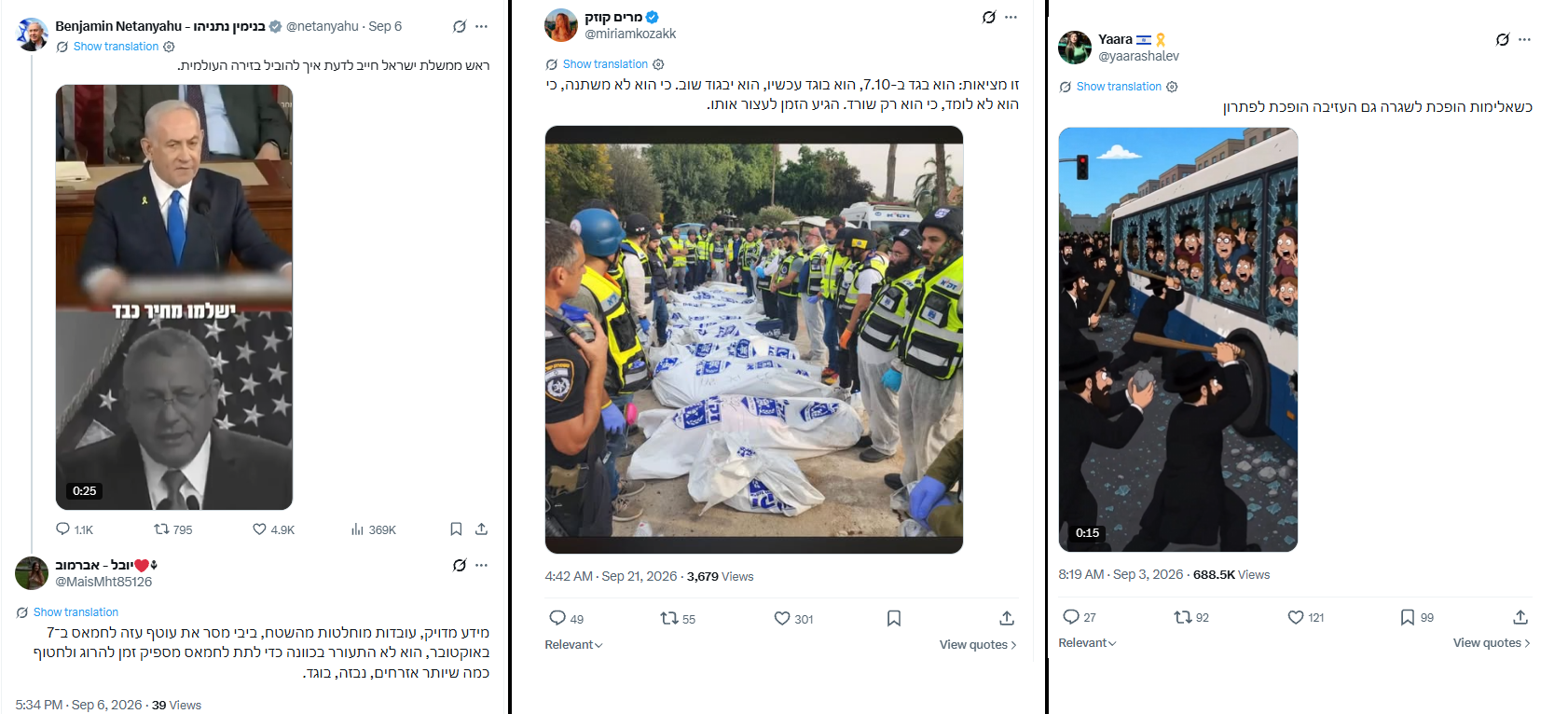
זו מציאות: הוא בגד ב-7.10, הוא בוגד עכשיו, הוא יבגוד שוב. כי הוא לא משתנה, כי הוא לא לומד, כי הוא רק שורד. הגיע הזמן לעצור אותו. “This is reality: he betrayed on 7.10, he is betraying now, he will betray again. Because he does not change, because he does not learn, because he only survives. The time has come to stop him.” @miriamkozakk, 21 September 2026 (3,616 views at the time of collection) |
|
ביבי מסר את עוטף עזה לחמאס ב־7 באוקטובר, הוא לא התעורר בכוונה כדי לתת לחמאס מספיק זמן להרוג ולחטוף כמה שיותר אזרחים, נבזה, בוגד. “Bibi handed the Gaza envelope to Hamas on 7 October. He deliberately did not wake up, to give Hamas enough time to kill and kidnap as many citizens as possible. Despicable. Traitor.” @MaisMht85126 (Europe / North Africa app), 6 September 2026; copied by @HerwtLherwt two days later |
12.2 Pillar two: treason and Qatari money
The Qatargate affair is framed as proof that Netanyahu sold Israel for money. Miriam Kozak's "We have a Qatari agent!" drew 5,009 views on 21 September. Yaara's version, "Money is stronger than any warning", came from KigVoice. Another Kozak post, "He sold us for money. Hundreds of millions. And because of that our sons and brothers were murdered", was the persona's most viewed post in our sample, at 9,594 views.
12.3 Pillar three: Haredi exemptions and unequal sacrifice
The draft-exemption dispute is framed as a moral contrast between those who "serve, work and pay taxes" and "draft-dodging parasites" kept in power by Netanyahu. It is Yaara's signature theme: "Netanyahu is asking for your vote again. For what? More exemptions for the Haredim, more taxes and pressure on the working public, more Qatari penetration, and more security failures."
12.4 Pillar four: war for survival, and an election that may be stolen
|
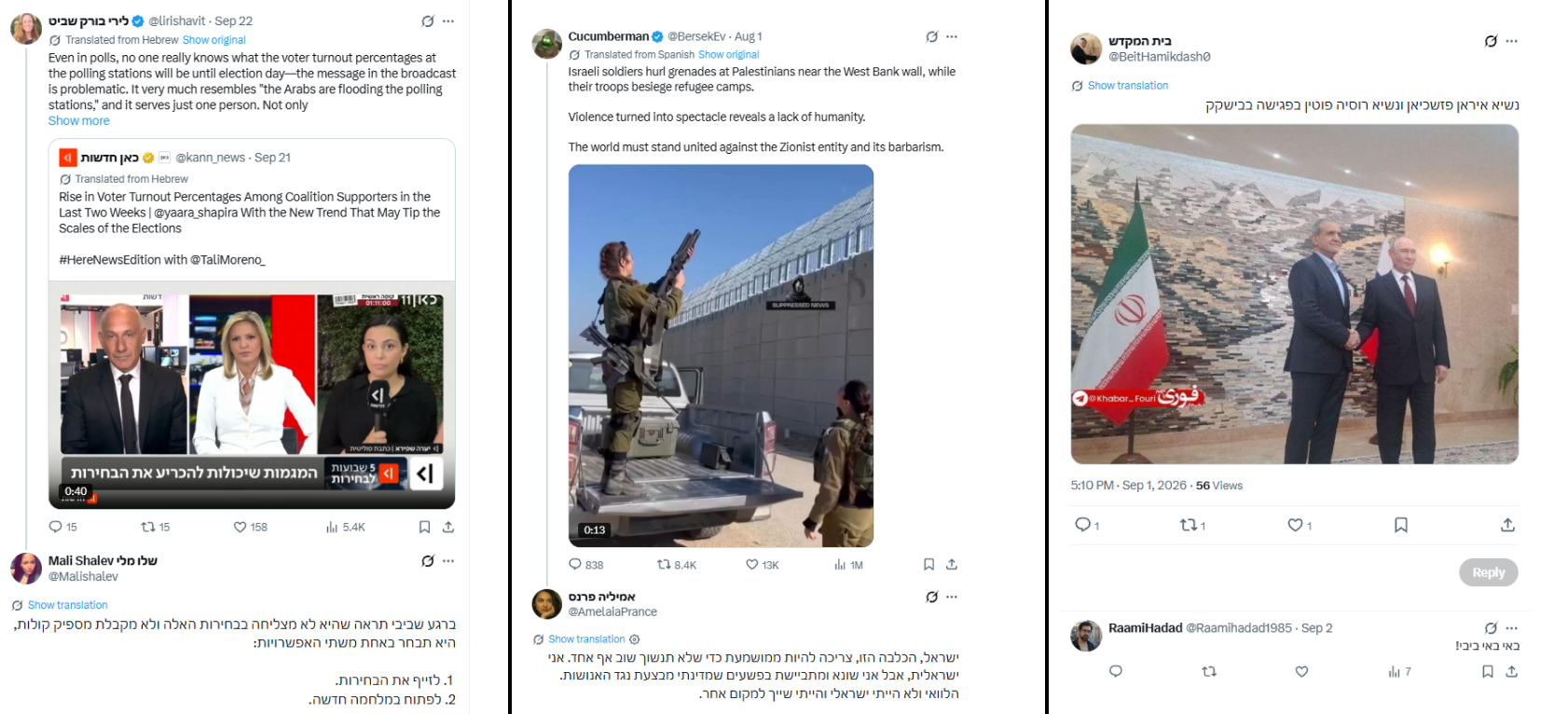
ברגע שביבי תראה שהיא לא מצליחה בבחירות האלה ולא מקבלת מספיק קולות, היא תבחר באחת משתי האפשרויות: 1. לזייף את הבחירות. 2. לפתוח במלחמה חדשה. “The moment Bibi sees that she [sic] is not succeeding in this election and not getting enough votes, she will choose one of two options: 1. Rig the election. 2. Start a new war.” @Malishalev (Bangladesh), posted twice on 22 September 2026, with Netanyahu referred to in the feminine |
This pillar matters most for election day. It primes Israeli audiences to read any security escalation as a political manoeuvre, and any defeat for their camp as fraud.
12.5 Pillar five: collapse, emigration and the delegitimisation of the IDF
The most corrosive content says that Israel is finished and that leaving is rational. Yaara's most viewed post in our collection, at 688,434 views, reads "When violence becomes routine, leaving becomes the solution". A companion post says "Israel is not emptying by chance". @EdenBoker_, of the Miriam cell, claims that "300,000 Israelis left during his term". @Anatlevy_67 goes further, calling on reservists to refuse service and describing the army as a militia:
|
פעם היינו גאים לשרת היום זו בושה. כשהימין הקיצוני שולט בצבא והופך אותו למכונת הרג בלי גבולות לסרב זה הדבר הכי ערכי שנשאר. “We used to be proud to serve; today it is a disgrace. When the far right controls the army and turns it into a killing machine without limits, refusing is the most principled thing left.” @Anatlevy_67 (created May 2026), 17 September 2026. Elsewhere: "The passport remains the only salvation." |
@AmelaiaPrance, which presents as a pro-Bennett Israeli woman in Hebrew, dropped the mask when replying to Turkish accounts: "Israel, this bitch, needs to be disciplined so that it doesn't bite anyone again. I am Israeli, but I hate and am ashamed of the crimes my country commits against humanity." No Israeli opposition voter writes this. It is the language of an operator addressing a different audience.
12.6 Pillar six: the countdown and the call to vote
The personas maintain a running countdown to "27.10" ("52 days to the turnaround", "35 days to the election", "27.10: we will stop him") and a direct call to vote Netanyahu out. That call is copied, as shown, from a government-named Iranian channel.
12.7 Both poles
The network is not ideologically committed. "Miriam Kozak" pushed claims of Arab electoral fraud and anti-left messaging in 2022, and switched sides later. Inside the current Iran-app ring, @BeitHamikdash0 runs a right-wing "Temple Mount" identity from Jerusalem that posts about IRGC threats and a Pezeshkian-Putin meeting, and bulk-retweeted 35 posts of a single account within two minutes. It posted within ten minutes of the anti-Netanyahu persona @E_katrina_s 260 times in the collection window. Running both camps is how an operation maximises friction rather than any electoral outcome.
12.8 Blending in: the vocabulary test
If the personas used a vocabulary unlike real Israelis, they would be easy to spot. We measured signature phrases across 1,573 original persona posts and 8,501 Hebrew posts from the Phase 1 election conversation:
|
Signature phrase |
Persona network |
Hebrew election discourse |
|
טבח נתניהו (the Netanyahu massacre) |
0.4% |
2.4% |
|
ממשלת הטבח / גוש הטבח (massacre government / bloc) |
2.0% |
0.4% |
|
בוגד / בגידה (traitor / treason) |
3.5% |
2.9% |
|
ממשלת ה-7.10 (the 7.10 government) |
0.0% |
0.1% |
|
27.10 (election-day countdown) |
0.9% |
0.5% |
|
חרדים / משתמטים (Haredim / draft dodgers) |
5.1% |
7.7% |
The result is itself a finding. For most slogans the personas use the language of the authentic opposition at similar rates. They are built to blend in. The clearest outlier is the collective "massacre government / massacre bloc" framing, which appears about five times more often in the network than in ordinary discourse. That rate reflects the Cluster B writers, who use it as a house style.
|
EVIDENCE 7: The content model
Representative posts for the pillars described above. Upper image, left to right: @MaisMht85126's reply under Netanyahu's account claiming he "deliberately did not wake up" on 7 October; @miriamkozakk's treason post, published over a photograph of 7 October victims (21 September, 3,679 views); and @yaarashalev's AI-generated video of Haredi men attacking a bus, captioned "When violence becomes routine, leaving becomes the solution" (3 September, 688.5K views). Lower image: @Malishalev's "rig the election or start a new war" reply under a post by journalist Liri Borak Shavit; @AmelaiaPrance's "Israel, this bitch..." reply under a Spanish-language anti-Israel post; and the right-wing persona @BeitHamikdash0's post on the Pezeshkian and Putin meeting, answered by @Raamihadad1985 of the Iran-app ring. Sources: x.com/MaisMht85126/status/2096622958567407686 | x.com/miriamkozakk/status/2101864606259884418 | x.com/yaarashalev/status/2095396239391023256 | x.com/Malishalev/status/2102297356741812338 | x.com/AmelaiaPrance/status/2083905519035507019 | x.com/BeitHamikdash0/status/2094805095632294213 |
13. Echoing Tehran: alignment with Iranian state narratives
To test whether the content model tracks the preferences of the Islamic Republic, we reviewed the election coverage of Persian-language Iranian state and state-aligned media between May and September 2026, including IRNA, Tasnim, Mehr, Fars, ISNA, the state broadcaster's news services and Jam-e Jam. We then compared their framing, pillar by pillar, with the personas' output.
13.1 How Tehran frames the Israeli election
|
Date |
Outlet |
Framing |
|
16 May 2026 |
The election is "a referendum on 7 October 2023 and the legacy of Benjamin Netanyahu", organised around five fault lines: 7 October, Haredi conscription, the economy, the judiciary and Netanyahu's legacy. | |
|
Jun to Jul 2026 |
Haredi concessions are presented as the price of Netanyahu's survival: "Will concessions to the Haredim help Netanyahu win?" | |
|
Jul 2026 |
Netanyahu may seek pretexts to cancel or postpone the election. | |
|
Aug to Sep 2026 |
"Netanyahu's electoral gamble with Iran: will the 'viper' ignite war again?" War is framed as an electoral instrument. | |
|
Sep 2026 |
Amplifies Ehud Barak: "If even five days before the election Netanyahu feels he is going to lose, he will begin a third round of war against Iran." | |
|
Sep 2026 |
"The ominous crossroads of the Zionist regime's election: from street disorder to civil war." |
Two features of the Iranian coverage stand out. First, Tehran does not endorse any Israeli candidate. It amplifies opposition polling because Netanyahu's decline supports a story of Israeli crisis, not because it wants his rivals in power. Second, much of the coverage recycles genuine Israeli criticism, selected and headlined so that separate grievances (7 October, hostages, Haredim, courts, war and polls) form a single narrative of decline.
13.2 The alignment
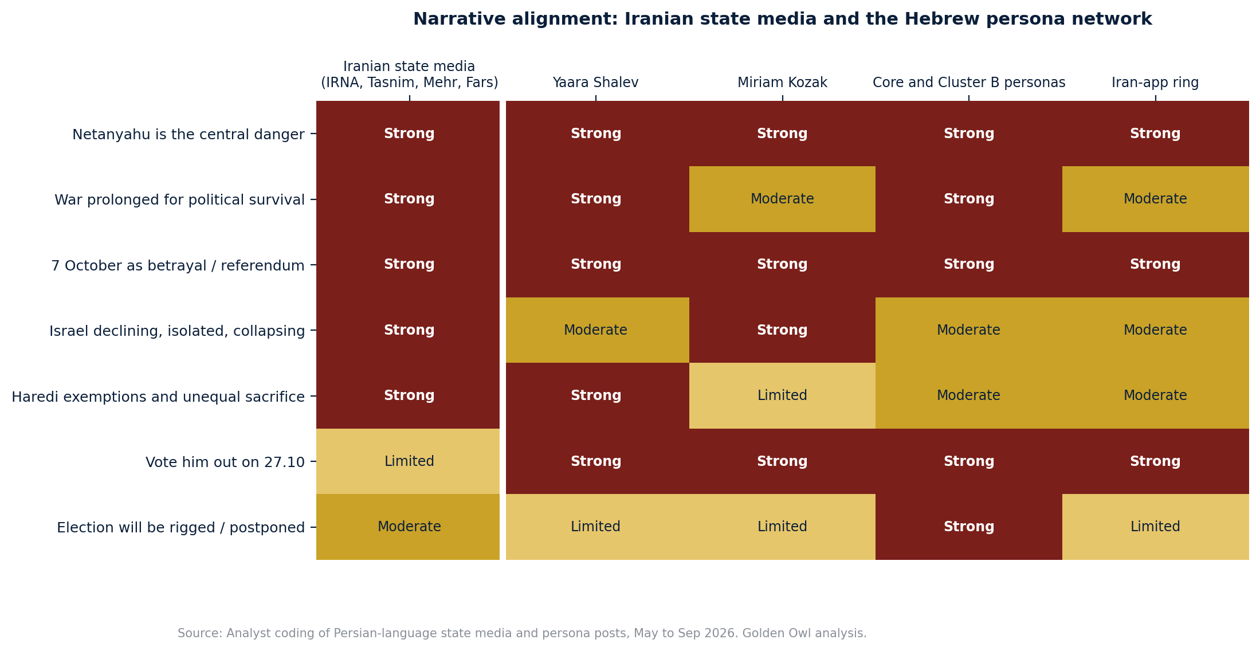
Figure 6. Narrative prominence coded from 0 (absent) to 3 (strong) in Iranian state media and in the persona layers. This is analyst coding of the reviewed material, not a statistical model.
The personas reproduce Tehran's package almost completely, translated into first-person Israeli grievance. The strongest overlap lies in the causal chain. Iranian outlets argue that Netanyahu widens regional war to secure his personal political survival, that Israeli soldiers and civilians pay the price, and that the election is the reckoning. Yaara's June post on the Iran war, Miriam's "he only opens fronts", VSeaberg's "Netanyahu is prepared to sacrifice soldiers for an extreme coalition" and the Iran-app ring's Democrats hashtags all follow that chain.
13.3 Where the personas go further than Tehran
· They tell Israelis how to vote. Persian outlets describe Israel's crisis to their own public. The personas, speaking as Israelis, urge Israelis to act on it: "Your vote is your power". That is audience adaptation, and the KigVoice pipeline shows the adapted slogans coming from an Iranian channel.
· They escalate from failure to treason. Iranian media mostly use the language of failure and responsibility. The personas escalate to deliberate betrayal ("he deliberately did not wake up").
· Miriam Kozak is openly Iran-favourable. It wrote that "Iran is on the way to victory" and that "Hamas is here, Hezbollah is here, Iran is laughing at everyone". In August 2026 it wrote: "Bibi is the best prime minister for the Iranians... If you ask the Iranians: let Netanyahu be the next prime minister." During Iranian missile attacks it spread a false claim of 23 civilians killed in Nahariya and asked "Don't we have any interceptors left?"
· They push harder on fraud. Malishalev's "rig the election or start a war" is sharper than anything in the Persian establishment coverage, which prefers postponement and manufactured-emergency scenarios.
13.4 What alignment does and does not show
Narrative alignment is never treated as proof on its own, because many of these arguments are also made in good faith by genuine Israeli critics. Here the alignment does not stand alone. It is carried by accounts that connect through the Iranian app, by an Iranian user's rebranded account, by personas operated from the Arab world, and by a persona that systematically republishes a government-named Iranian channel. Taken together, these make the alignment operational rather than coincidental: the network is a delivery mechanism for the narrative the Islamic Republic wants Israelis to absorb before 27 October.
14. How the network reaches real Israelis
Many personas in this network deliberately keep a low profile. That is a design choice, not a weakness: their influence comes from placement, repetition and borrowed amplification, which carry their messages to audiences far larger than their own followings. Together with the two flagship personas, they generated roughly one million views in a single month (Section 14.4).
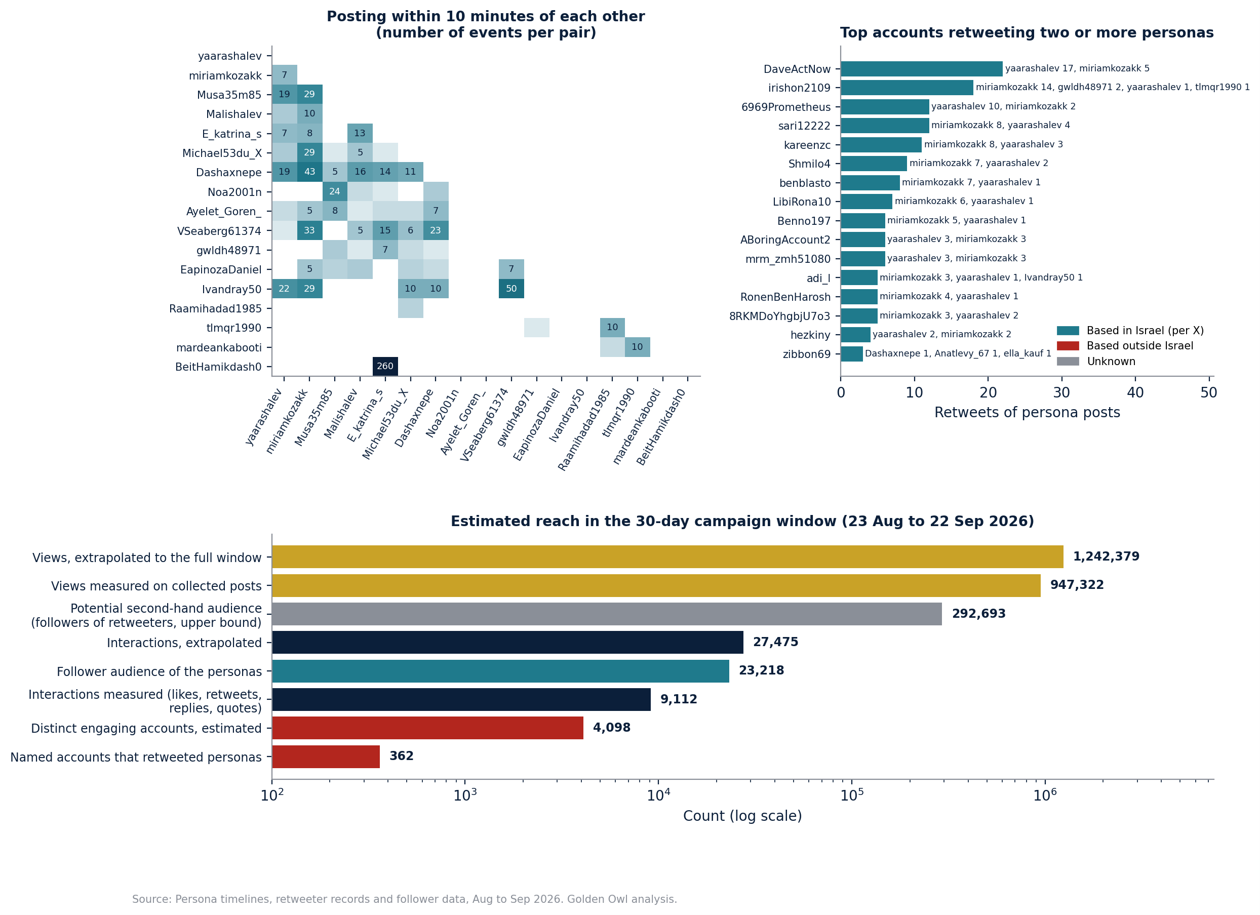
Figure 7. Top left: pairs of personas posting within ten minutes of each other, by number of such events. Top right: the accounts that most often retweeted two or more personas, coloured by where X locates them. Bottom: estimated reach of the network in the 30-day campaign window, from total views down to named accounts (logarithmic scale; see Section 14.4 for method).
14.1 Reply seeding under large accounts
The personas concentrate their replies under the same large, authentic opposition accounts, such as @BaruchSharon1 (retweeted or engaged by 13 of the 21 seeds), @AmiDror (connected to 18 of them), @lirishavit, @gadi_eisenkot and @YairGolan1, where visibility is high and the audience is already receptive. @VSeaberg61374 published 20 one-line anti-Netanyahu replies to 20 different accounts in fifteen minutes on 22 September, and 30 more on the previous morning. @Musa35m85 posts about ten items a day, 79% of them replies, built on one rigid template.
14.2 Choreography between personas
· Companion personas reply under Yaara in the evening. Yaara answers them the next morning, for example replying to Malishalev, E_katrina_s and Musa35m85 within seven minutes on 21 September (06:13 to 06:20 UTC).
· Pairs of personas repeatedly post within ten minutes of each other: Dashaxnepe and miriamkozakk 43 times, VSeaberg61374 and miriamkozakk 33, Ivandray50 and VSeaberg61374 50, and BeitHamikdash0 and E_katrina_s 260.
· Miriam Kozak retweets its own posts in bursts (53 of 120 recent items) and retweeted three posts of a 17-follower feeder within 104 seconds.
14.3 Borrowed amplification
Across the persona posts we collected, 362 distinct accounts (not counting the personas themselves) retweeted at least one persona, and 27 retweeted two or more. Of the retweeters whose location X discloses, 276 of 362 (76%) are based in Israel. Most are genuine Israeli opposition supporters who have no idea who they are amplifying. A minority are throwaway amplifiers, such as accounts with auto-generated handles that have posted 20,000 or 40,000 times since late 2025 while having a handful of followers.
This is the decisive mechanism. A foreign-operated persona drops a line into a busy Israeli thread. Real Israelis like, retweet and repeat it. By the second step the content has an authentic Israeli face, and the operation's fingerprints are gone. The top outside amplifier of the network, @DaveActNow, is itself Israel-based, and it follows Press TV Hebrew and is mutual with the government-named Kol Hamappa.
14.4 Engagement and audience: how many accounts did the network reach?
To estimate the network's footprint, we measured every post authored by the 31 network accounts that were active in the 30-day campaign window (23 August to 22 September 2026). Retweets of other people's content were excluded, and duplicate records were removed. The overt Iranian outlets (Press TV Hebrew, Iran Hayom) are not counted. Because timelines were collected up to a fixed number of recent posts, the most prolific accounts (Miriam Kozak, for example) are covered for only part of the window. For those accounts we also give a linear extrapolation to the full 30 days.
|
Measure |
Measured |
Full window (est.) |
What it means |
|
Posts authored by the network |
1,191 |
1,754 |
Original posts, replies and quotes |
|
Views (impressions) |
947,322 |
1,242,379 |
Times the posts were displayed; one person can see several posts |
|
Interactions |
9,112 |
27,475 |
6,589 likes, 1,108 retweets, 1,240 replies and 175 quotes (measured) |
|
Distinct accounts that engaged |
~4,098 |
~12,355 |
Estimated. 362 are identified by name as retweeters; see method note |
|
Named accounts that retweeted personas |
362 |
|
76% based in Israel according to X |
|
Follower audience of the personas |
23,218 |
|
Sum of follower counts; some followers overlap |
|
Potential second-hand audience |
up to 292,693 |
|
Combined followers of the accounts that retweeted personas (upper bound) |
|
IN PLAIN TERMS ■ In the month before this report, content from the persona network was displayed roughly one million times (947,322 measured, about 1,242,379 for the full window). ■ It generated 9,112 measured interactions, about 27,475 over the full window. ■ We estimate that between about 4,100 and 12,400 distinct accounts actively engaged with it. 362 of them are identified by name, and 76% of those are based in Israel. ■ Through the people who retweeted it, the content was pushed toward the feeds of up to about 290,000 further accounts. |
Where the reach comes from
|
Layer |
Posts |
Views |
Views (est. full window) |
Interactions |
Per 100 views |
Followers |
|
Core persona cell (Yaara hub) |
596 |
827,673 |
883,454 |
1,663 |
0.2 |
584 |
|
Miriam cell |
88 |
79,994 |
267,810 |
5,851 |
7.3 |
21,057 |
|
Cluster B writers |
198 |
24,286 |
73,956 |
1,446 |
6.0 |
1,407 |
|
Iran-app ring |
117 |
10,862 |
12,187 |
114 |
1.0 |
87 |
|
Reply cannon |
152 |
3,135 |
3,223 |
27 |
0.9 |
13 |
|
Named media-style channels |
40 |
1,372 |
1,749 |
11 |
0.8 |
70 |
Two flagship personas carry the largest audiences. Yaara Shalev accounts for 83% of measured views, driven above all by one emigration video ("When violence becomes routine, leaving becomes the solution") that was displayed 688,434 times. Without that single post, the network's measured views would be about 258,888. Miriam Kozak accounts for 63% of all interactions. The wider persona layer multiplies that reach. Its accounts seed replies under large Israeli accounts, manufacture the appearance of agreement, and feed lines to the anchors; the Iran-app ring alone generated 10,862 views in the window while operating as a distribution layer.
|
Account |
Layer |
Posts |
Days covered |
Views |
Views (est.) |
Interactions |
|
@yaarashalev |
Core persona cell (Yaara hub) |
108 |
29 |
788,649 |
825,763 |
1,249 |
|
@miriamkozakk |
Miriam cell |
47 |
9 |
76,568 |
264,384 |
5,714 |
|
@WYylwn41269 |
Cluster B writers |
40 |
7 |
14,516 |
59,908 |
1,245 |
|
@Musa35m85 |
Core persona cell (Yaara hub) |
97 |
13 |
11,567 |
27,537 |
154 |
|
@Michael53du_X |
Core persona cell (Yaara hub) |
82 |
30 |
16,162 |
16,162 |
90 |
|
@tlmqr1990 |
Iran-app ring |
20 |
29 |
8,429 |
8,829 |
18 |
|
@ArgamanEvelyn |
Cluster B writers |
39 |
12 |
2,840 |
6,821 |
71 |
|
@E_katrina_s |
Core persona cell (Yaara hub) |
80 |
30 |
4,129 |
4,129 |
60 |
|
@polinaRamannova |
Core persona cell (Yaara hub) |
40 |
14 |
1,712 |
3,554 |
20 |
|
@EdenBoker_ |
Miriam cell |
18 |
30 |
2,996 |
2,996 |
127 |
The effect on the audience
· Audiences respond to the personas as if they were real. Across all network posts there were 1.0 interactions per 100 views. In the ordinary Hebrew election conversation on X from Phase 1 (8,492 posts) the rate was 2.8. Where the network has built a following, it far exceeds that baseline: the Miriam cell draws 7.3 interactions per 100 views and the Cluster B writers 6.0, more than twice the norm. These audiences are not merely exposed. They like, reply and share.
· Yaara's videos travel far beyond her followers. They are watched far more than they are discussed (about 0.2 interactions per 100 views for the core cell). That is the profile of algorithmically distributed video, which carries the emigration and decline message to audiences who never follow the account.
· The amplification is authentic Israeli amplification. 76% of the named retweeters are located in Israel. Every one of those retweets relays a foreign-operated persona's message to that person's own followers with an Israeli face attached.
· Past effects are documented. The Miriam Kozak persona's AI image of Netanyahu was circulated by genuine Israeli politicians as evidence of incitement (2024), and its fake Facebook group for MK Naama Lazimi drew about 8,000 genuine Israeli members before removal (2025). The same persona now reaches tens of thousands of views a week on X.
Method note. Views are impressions, not unique people. Follower counts overlap between accounts. X does not reveal who liked a post, so the number of distinct engaging accounts is estimated from the one interaction type that can be resolved to named accounts: across 805 retweet records we found 362 distinct retweeters, a ratio of 0.45 accounts per interaction. That ratio is applied to all interactions. The second-hand audience sums the followers of the retweeters without removing overlap and is an upper bound. All other figures are lower bounds, because timelines were capped and the second-hop expansion covered only suspicious neighbours.
15. The architecture: from visible amplification to embedded personas
Golden Owl's February 2026 research described an Islamic Republic-linked influence architecture with differentiated roles: originators, amplifiers, automated or centrally operated accounts, and less visible actors embedded in communities whose trust they could draw on during a crisis. The election investigation shows how that role-based approach can be adapted to a domestic electoral audience. The most consequential activity is not necessarily the most visible. A low-profile seeding layer supplies material, while accounts presenting as Israelis carry it into political debate through posts, replies and coordinated amplification.
Several patterns define the architecture observed in the election case:
· The source is separated from the public voice. KigVoice's limited visibility contrasts with the reach of Yaara Shalev, who republished 14 of its captions as her own posts.
· The visible accounts appear local and varied. Personas present as Israeli women, reservists, secular voters or religious activists. Some use patriotic imagery and first-person accounts of national concerns. Their political positions are not uniform.
· Coordination is distributed. Different accounts seed replies, repeat text, publish media or reinforce another persona's posts. Shared wording, timing, account histories and network relationships expose connections that individual posts do not.
· The operation enters existing debates. Its accounts use grievances and language already present in authentic Israeli discussion. Political viewpoint alone cannot distinguish an operated persona from a genuine voter.
· Real users form the outer reach of the network. Israelis who engage with persona content can extend its circulation, but their interaction does not make them participants in the operation.
Compared with the broader network examined in February, this case places particular weight on concealing the seeding layer and embedding coordinated activity among less obvious accounts. The two studies examine different audiences and datasets; they establish a development in the observed method across these cases, not a measured replacement of every earlier tactic.
15.1 Efficiency and operational economy
This architecture can generate exposure without requiring every operated account to become prominent. A caption can be produced once, carried by a more credible persona, reinforced by small accounts and then repeated by authentic users. In the documented KigVoice-Yaara transfers, the 14 source posts received a combined 188 views, while Yaara's republications received 13,077. That difference illustrates the value of moving material from a low-visibility source to a better-placed public voice; it does not, by itself, measure the operation's total impact.
The network also gains efficiency from reuse and placement. Copied text reduces the need to create a distinct message for each persona. Replies beneath established Israeli accounts give small profiles access to active audiences without first building large followings. Varied identities allow the same broad themes to enter different communities, while genuine engagement extends distribution beyond accounts the operators appear to control.
The economy is therefore one of content, attention and visibility: a relatively obscure source can support multiple public-facing actions, while modest activity travels through conversations that already exist. Distributing those actions among small accounts also makes coordination harder to recognise from posting volume alone. Compared with the broader, more visible amplification patterns documented in Golden Owl’s February research, the election case shows the Islamic Republic–linked method operating through quieter seeding, plausible local identities and borrowed reach, an adaptation that increases concealment while making more use of each message and account.
16. Attribution and confidence
16.1 Assessment by layer
|
Layer |
Assessment |
Confidence |
Basis |
|
Iran-app ring |
Operated by actors using the Iranian X client, presenting as Israelis |
High |
Platform-attested Iranian client on four personas; Persian history of "Alon Strauss"; 114 Iranian follows; exclusive tag block; mutual-follow ring |
|
Yaara Shalev and the KigVoice pipeline |
Part of the Iran-operated Hebrew network |
High |
Flagged by Golden Owl's anomaly detection; 14 one-directional caption transfers from KigVoice, including identical AI videos; borrowed and synthetic profile imagery; repurposed 2012 account; follows Kol Hamappa; also cited in the government assessment |
|
Core persona cell |
Coordinated inauthentic personas under common management |
High |
Verbatim shared text; handle changes 11 minutes apart; reply choreography; foreign locations (Bangladesh, Italy); gender and typing artefacts |
|
Miriam cell |
Foreign-operated persona with probable Iranian association |
High (inauthenticity), medium-high (Iran) |
Prior exposure; Europe base; self-amplification; Iran-favourable content; engaged by Kol Hamappa |
|
Cluster B writers |
Coordinated writers operated from Europe, North Africa, Lebanon and West Asia |
Medium-high |
Shared text; shared " .. " style; identical North Africa and West Asia app fingerprints; Press TV Hebrew reply reused |
|
Arab-world Hebrew personas |
Foreign-operated Israeli personas linked to the network |
Medium |
Platform location in Egypt, Saudi Arabia, Yemen, Lebanon and Morocco; Israeli self-presentation; links to the seeds |
16.2 Competing hypotheses
|
Hypothesis |
Assessment |
|
A. An Iran-operated Hebrew persona network, using Iranian and regional operators and European connection points |
Best supported. It explains the Iranian client build, the Persian-to-Hebrew rebrand, the government-named assets and the one-way caption pipeline, the Arab-world locations, non-native Hebrew with Arabic-script artefacts, and alignment with Iranian state narratives. |
|
B. Genuine Israelis abroad using VPNs |
Weak. It does not explain the Iranian client build, Arabic keyboard traces, gender errors, identical texts across personas, coordinated renames, accounts registered 30 seconds apart, or a Persian speaker's account becoming "Alon Strauss". |
|
C. A commercial or third-country operator, for example a contractor with Russian-speaking staff |
Partially compatible. Russian-language personas ("Dasha", "Ekaterina") and the Romania / Ukraine app pair show that the operation uses varied infrastructure and possibly outsourced labour. This is consistent with, not an alternative to, Iranian tasking, and does not change the overall assessment. |
|
D. Organic copycats inspired by viral content |
Weak for the core; possible at the periphery. Organic users do not republish a nine-follower channel's captions fourteen times without attribution, or paste feminine insults at male targets. |
16.3 Accounts we excluded
Rigour requires showing what is not part of the operation. The following were examined and excluded:
· @macho_man36, a US-based English-first hobbyist producing labelled AI parodies. Probably genuine.
· @bain_rami, an Israel-based account whose insult was harvested by the personas. A victim of copying, not a member.
· The large opposition accounts the personas reply to and farm (@AmiDror, @BaruchSharon1, @lirishavit, @YairGolan1 and others). These are targets and vectors, not members.
· Israeli journalists that X labels "West Asia" (for example Tal Schneider and Ilan Lukatch), and a prominent journalist it labels "Sri Lanka". Location labels alone are not evidence.
· Commercial spam accounts in Nigeria, Benin and Thailand that use Hebrew names to sell services.
· The roughly three quarters of retweeters who are genuine Israelis.
17. Implications for 27 October
With five weeks to go, the network is active, growing, and aligned with the narratives most likely to matter on and after election day. Three risks stand out:
1. A pre-built legitimacy crisis. The personas are already telling Israelis that Netanyahu will "rig the election or start a new war" if he is losing. The authentic Phase 1 conversation shows both camps primed to call a defeat fraudulent. A foreign network that can inject synchronised claims into both camps on election night is positioned to magnify a real crisis.
2. Security events as "campaign theatre". Any military escalation before 27 October will be framed by this network, as it already is by Iranian and allied media, as a manufactured emergency. That erodes trust in genuine security warnings.
3. Demoralisation and turnout. Emigration, refusal and "the country is finished" messaging, with reach of up to 688,000 views for a single post, targets civic confidence itself, not any one party.
Indicators to monitor through election day
· Synchronised posts from the network claiming Netanyahu is manufacturing a security emergency, delaying the election or preparing fraud.
· New KigVoice captions reappearing on Yaara Shalev or other personas; new Iran-app accounts following the ring.
· Activation of right-wing personas (the BeitHamikdash0 model) with mirror-image fraud claims against the opposition, the courts or Arab voters.
· False voting information: fake polling-station changes, "online voting" links, postponement claims.
· Bulk account renaming or creation in the final two weeks.